
AR Rental Tools
LINE
Rental tips

Scheduling Rented Equipment by Build Phase: What to Bring In, and When to Send It Back

August 24, 202610 min read

Scheduling Rented Equipment by Build Phase: What to Bring In, and When to Send It Back

What an equipment schedule is, and why renting everything at once costs you

An equipment schedule sets the date each machine arrives on site and the date it goes back, following the actual sequence of work rather than dropping everything on site on day one and returning it all at the end. On a mid-sized job the difference between the two runs into tens of thousands of baht.

People bring everything in early because they are afraid a machine will not be free when they need it. The fear is reasonable; keeping machines on standby for the whole job is not the fix. Book ahead with the dates you want, and have each machine arrive for the window it is actually used in.

The cost of idle equipment is hard to see because it never appears as a new line on the bill. It hides inside the day count of a line that is already there. A machine used for one day but parked on site for eighteen is still billed for eighteen.

Most jobs break into four phases that each use a different group of machines: breaking out, earth and compaction, concrete, and high work with steel. Scheduling against those four phases is the simplest way to cut idle days out of the bill.
Phase one: breaking out and opening up the site

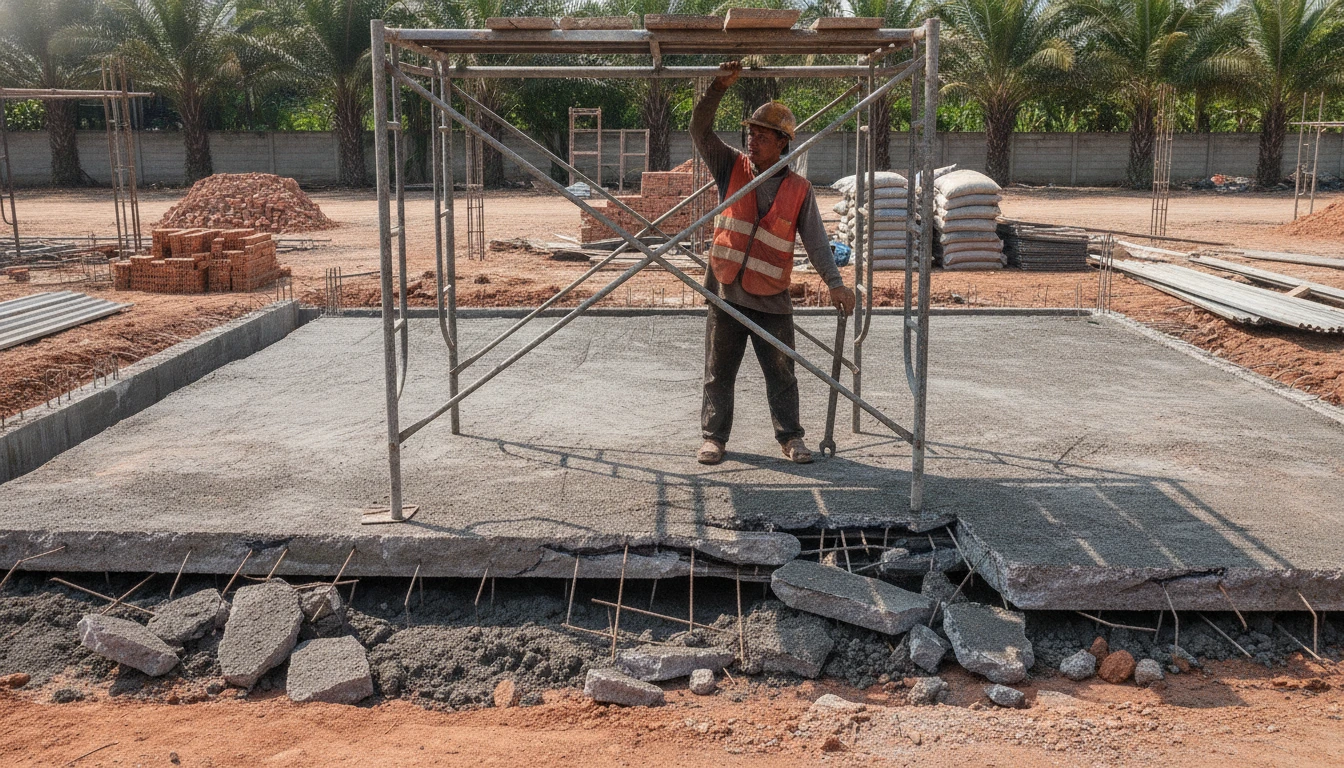
The first phase removes what is already there. It is usually the shortest phase and uses the most powerful machines. The main one is an electric breaker at 500 THB per day for slab and render removal, with a concrete saw at 1,000 THB per day where a clean line has to be cut before breaking.

If the work is drilling holes for anchors or conduit rather than breaking, use a rotary hammer instead, from 300 THB per day for the small unit. Getting that distinction right at the start avoids renting the wrong machine, trying it, and swapping later.

There is almost no reason to hold this group past the end of the breaking phase, because the next phases use entirely different machines. This is the earliest and clearest return in the whole schedule.

The thing to allow for here is debris volume, which is always larger than people expect. If the site has nowhere to stack it, the phase stretches while waiting for removal, and those extra days are rental days on a breaker sitting on site.

Scheduling Rented Equipment by Build Phase: What to Bring In, and When to Send It Back

Phase two: earth works and compaction

Once the old material is out, the ground is levelled and compacted before anything is poured. Skipping or under-doing this is what makes a new slab settle and crack later, and putting that right afterwards costs many times the rental.

The main machine is a petrol plate compactor at 750 THB per day, which suits tight areas, footings and corners. For wide areas such as car parks or estate roads, a walk-behind roller at 1,500 THB per day gives a more even finish and works faster.

On house and extension jobs this phase is very short, typically 1-3 days. That makes it another place not to hold equipment. Book it in for the window when the ground is genuinely ready, and return it as soon as the level is right.

These machines run on petrol and diesel, so allow for fuel filled on site, and somewhere dry to keep them. If it rains before the ground is level, work stops but the rental does not, which is worth allowing for in the schedule.

Phase three: concrete, from mixing to finishing

Concrete is the phase that runs the most machines at once, and the only one where a weekly rate usually genuinely wins, because a concrete mixer at 500 THB per day or 3,000 per week has to stay for most of it.

Two machines follow it as a set: a concrete vibrator at 500 THB per day to drive air out of the pour, and a power screed at 1,500 THB per day to level the surface. Both are used only on pour days.

This is where the most expensive mistake on the whole job happens, because the screed and the vibrator get kept for the full duration when they were needed for one day. Holding the power screed for 18 days instead of returning it after one takes that single line from 1,500 THB to 24,000 THB.

If the site cannot supply enough power for this group, add a generator at 500 THB per day into the same window, and book it with the rest rather than calling for it once the site is already stuck.

Phase four: high work and steel

The last phase is everything done at height: rendering, ceilings, painting and steel erection. Its main item is steel scaffolding at 10 THB per piece per day, or 60 THB per piece per week, the only line billed by piece rather than by machine.

Because it is billed by piece, quantity matters more than duration. Thirty pieces for two weeks is 3,600 THB, while sixty pieces over the same period is 7,200 THB. Estimating pieces against the real height and wall length is what controls this phase's cost.

Where material has to go up repeatedly, compare a mortar hoist at 500 THB per day against the labour of carrying it. Jobs lifting mortar two floors or more, several trips a day, usually come out ahead on the hoist, and it is safer.

Steel erection uses a welding machine at 500 THB per day, generally only while the frame goes up. Book it for the days the welder is actually on site. The full list is on the equipment and pricing page.

A worked schedule: an 18-day rear extension

Take a mid-sized rear extension estimated at 18 working days, using eight machines that each arrive and leave at different points. This is the schedule and what it actually costs.

Only the scaffolding stays for most of the job, because it cannot be struck and re-erected repeatedly. Everything else comes and goes with its phase. Together the eight machines spend 44 machine-days on site rather than the 144 they would if everything were held throughout.

That 13,600 THB is machine rental only. It excludes cutting blades, fuel for the petrol machines, delivery in and out, which on a job like this means several trips, and the deposit. Delivery has to be asked for, because it is charged by distance and piece count.

The trade-off is real: this schedule needs several truck movements rather than one. If the site is far and per-trip delivery is high, combining some phases may work out better. Compare both versions with actual numbers before deciding.

What to check before signing for a delivery

A good schedule collapses the moment something arrives unusable, because the days lost waiting for a replacement push every later phase back. Inspecting at handover is the best-value five minutes on the whole job.

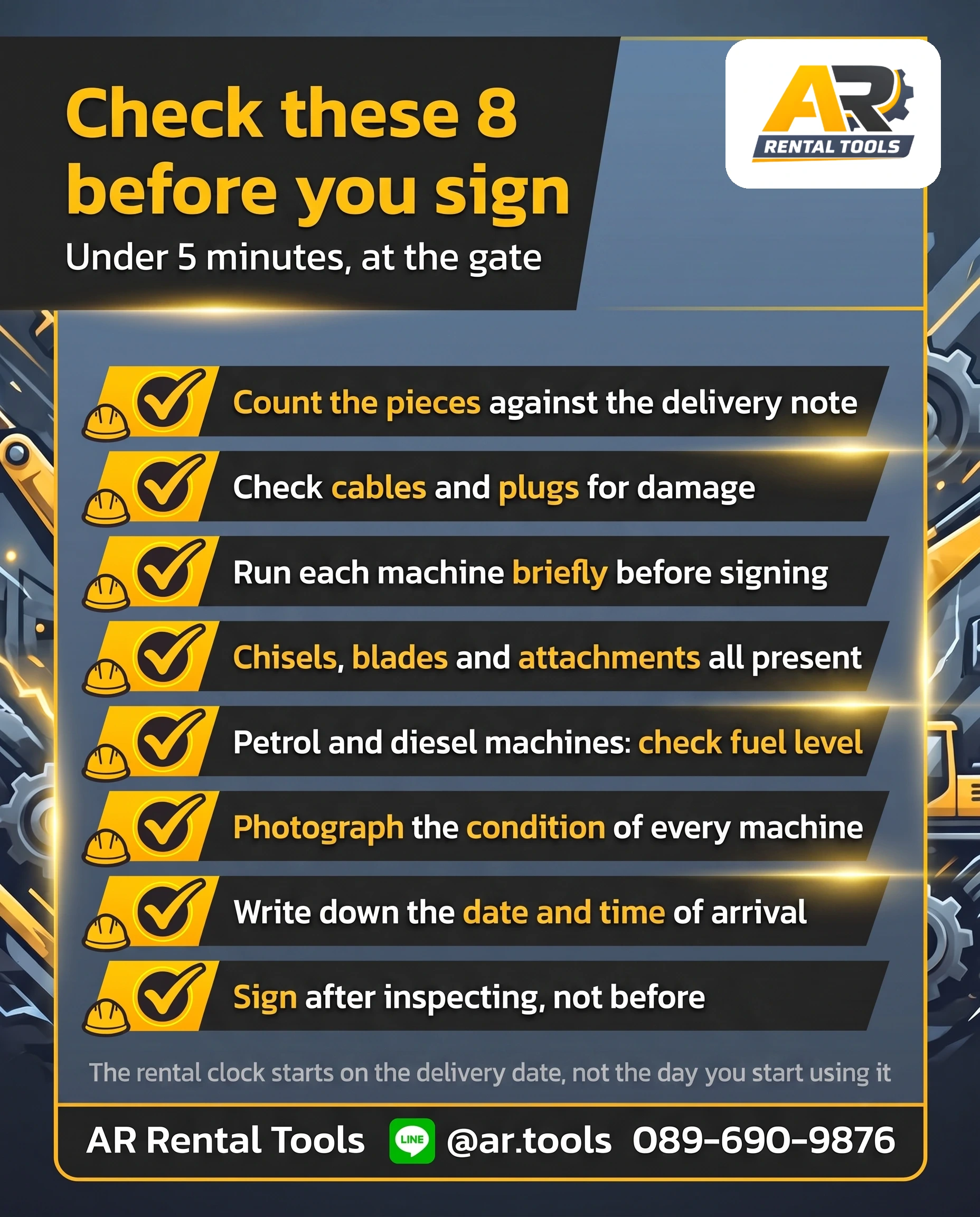
There are eight things to check. Count the pieces against the delivery note, check cables and plugs for damage, run each machine briefly before signing, and confirm that chisels, blades and attachments are all present.

The other four: check fuel levels on petrol and diesel machines, photograph the condition of every machine, write down the date and time of arrival, and sign after inspecting rather than before.

The one most often skipped is writing down the arrival time, because that date is the first rental day, not the day work starts. Equipment delivered on a Friday evening for a Monday start is three rental days that did no work.

Common mistakes, and the summary

The first mistake is booking everything for day one out of fear that machines will not be free. The better approach is to book ahead with a required date per machine. The team holds the slot without the rental clock starting on day one of the job.

The second is forgetting to return what is finished, particularly single-day machines like the power screed and the vibrator. Make it a site rule that whoever finishes reports it immediately, and book the collection for the next day.

The third is leaving no allowance for rain. Outdoor work in the wet season slips easily, and machines waiting on site keep billing. Put the expensive machines into the windows you can control best.

In short: split the job into four phases, write a separate in and out date for each machine, return things as soon as they are finished, and run the eight-point check at every handover. Rates are on the equipment and pricing page, or talk the schedule through via the contact page.

Frequently asked questions

Should I bring in all the equipment at once, or phase it?
Phasing is always cheaper, because rental is counted from the days equipment is on site rather than the days it is used. The safe way to do it is to book ahead and give the date you want each item, so the team holds the slot for that date without the rental starting on the first day of the job.
When do rental days start counting?
They start the day the equipment reaches the site, not the day you start using it. If a delivery arrives on Friday evening and work starts on Monday, those three days are still rental days. Schedule delivery close to the real start date, and record the date and time you take receipt every time.
What equipment does a house extension typically need?
Usually eight items, in job order: a breaker and a concrete saw for breaking out, a plate compactor for the earth works, a concrete mixer, a poker vibrator and a power screed for the pour, then scaffolding and a welding machine for the high work. Each one arrives and leaves in a different phase.
How far ahead should I book to get equipment on the dates I need?
The earlier you tell us, the more certain the slot, particularly in busy periods. Send the whole list with the in and out dates for each item in one message and the team will confirm truck scheduling and rates. Replies come within about 30 minutes during business hours.
Can I send equipment back early?
Tell the team as soon as you have finished with it and arrange a collection run. The sooner it goes back, the sooner the rental days stop, which matters most for items used for a single day such as a power screed. Make it a site rule that whoever finishes with a machine reports it immediately rather than waiting for the end of the job.

Get a quote

Send your build sequence with in and out dates per machine to 089-690-9876 or LINE @ar.tools, and the team will hold the slots and confirm truck scheduling for the whole set in one round.

Back to articles

Content updated: 2026

AR

Ready to start your project?

Talk to our team for a quote and rental details.