
AR Rental Tools
LINE
Rental tips

Rotary Hammer Rental in Bangkok: Pick by Impact Energy and Hole Size, Not by Price

October 19, 202611 min read

Rotary Hammer Rental in Bangkok: Pick by Impact Energy and Hole Size, Not by Price

A Rotary Hammer Rental and a Small Drill Differ in Impact Energy, Not in Body Size

Renting a rotary hammer that will not bite, and renting a small drill that burns its bit, are the same mistake seen from two sides. Both come from choosing by machine size or daily rate instead of by the one number that decides the job, which is how much impact energy the machine delivers on every blow.

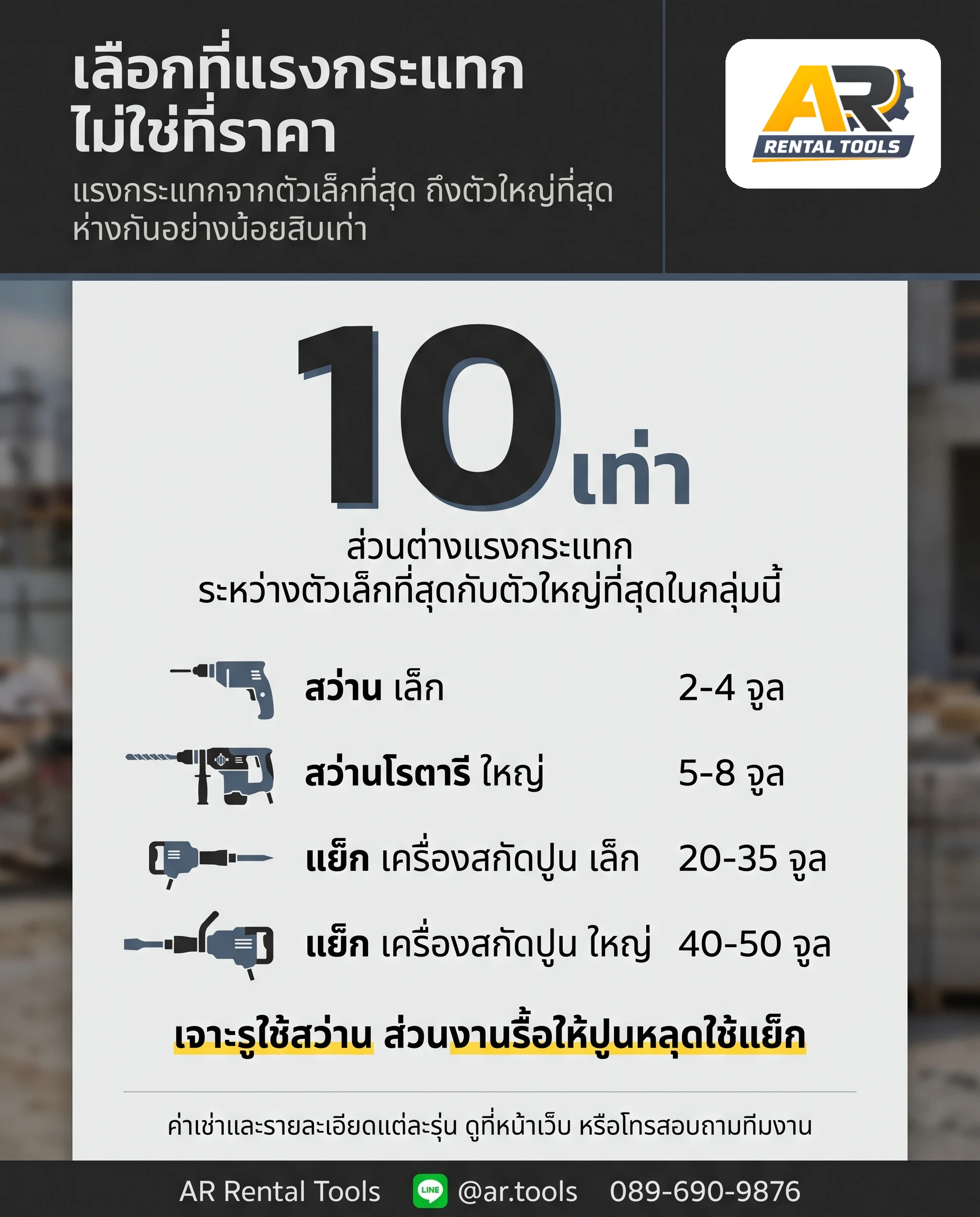
Impact energy is measured in joules, and across the drilling and breaking machines on hire here it runs from about 2 joules up to about 50 joules, a spread of ten times or more. The daily rate over that same span moves by 200 THB. That is why choosing by price does not help: the price barely moves while the capability moves across the whole board.

Two lines matter on site. The first is material, because lightweight block and clay brick are not the same job as concrete that was poured years ago and has fully cured. The second is hole size and hole count, because ten 6 mm holes and sixty 12 mm holes call for different machines even in the same wall.

This guide lines the four machines up by impact energy and pairs each band with real jobs. The rates quoted are the equipment hire per day: the small drill at 300 THB, the large rotary hammer at 500 THB, and the large electric breaker at 500 THB. Transport is charged separately by distance.
What a Rotary Hammer Is, and Why a Plain Drill Cannot Handle Concrete

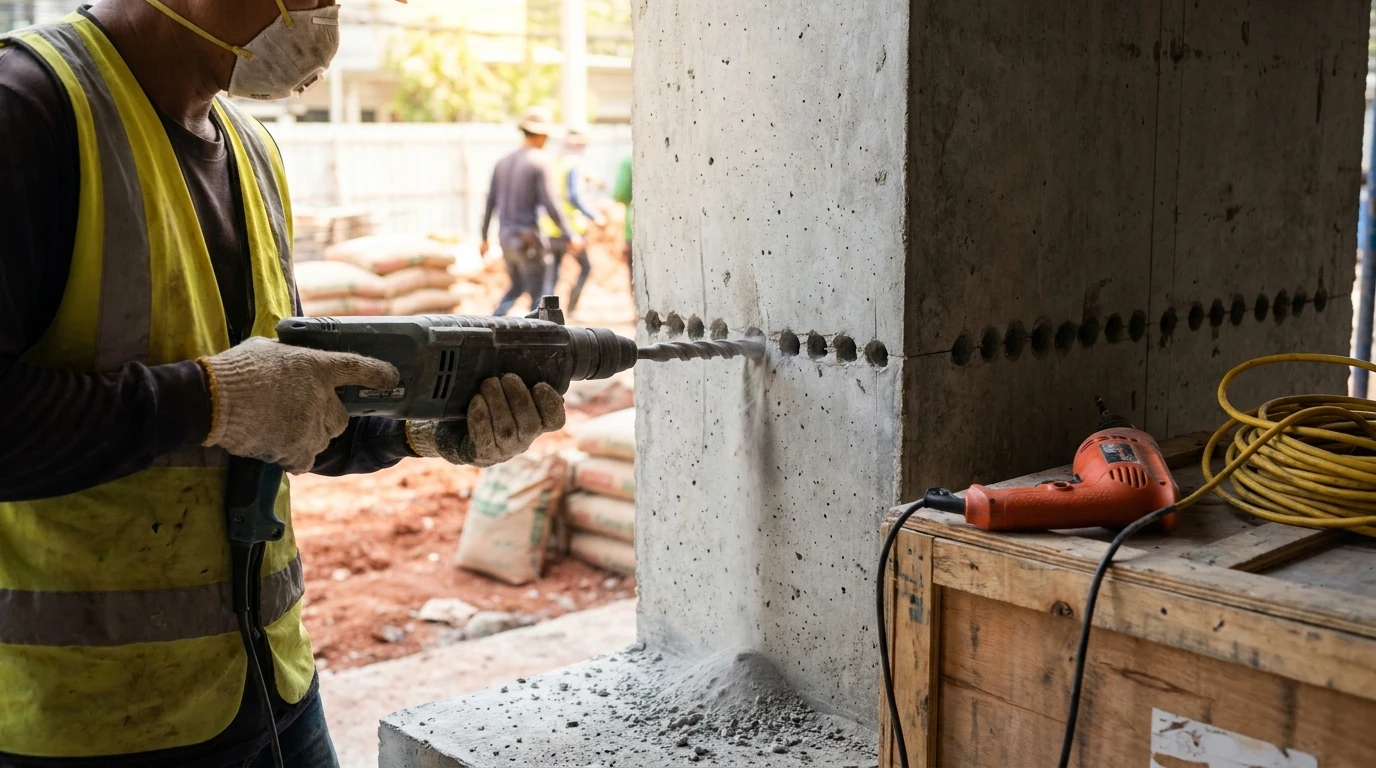
A rotary hammer does two things at once. It turns the bit forward and, in the same motion, strikes the bit into the surface in rapid pulses. That striking action is what lets the carbide tip shatter concrete into dust, which the flutes on the bit then carry out of the hole. A machine that only turns has no shattering step, so the tip merely rubs against the surface and heats up.

That single difference explains every symptom people describe on the phone. The bit sinks two or three millimetres and then stalls, the shaft gets too hot to hold, smoke comes off it, and the tip changes colour. All of it is a machine without enough impact energy trying to drill by friction. Pushing harder only heats it faster, because body weight adds no blows.

The opposite error causes a different problem. Lightweight block hit with twenty joules or more cracks around the hole rather than taking a clean round one, so the anchor never grips the material and the whole fixing point has to be redone.

The rule that travels well to site is this: impact energy should match the material, not be the highest you can afford. What counts as matching is in the next section.

Rotary Hammer Rental in Bangkok: Pick by Impact Energy and Hole Size, Not by Price

Four Impact-Energy Bands, from 2 Joules to 50 Joules, and Which Machine Sits Where

The first band is the small drill, at roughly 2-4 joules, about 0.7-0.9 kW on 220 V house power, and only about 3-5 kg. That light weight is a real advantage overhead or up a ladder, because arms tire far more slowly. Hire is 300 THB per day or 1,800 THB per week.

The second band is the large rotary hammer, at roughly 5-8 joules, about 0.9-1.2 kW, and about 7-9 kg. This is the machine that covers most concrete drilling in installation work, from anchoring conduit trays to fixing steel shelving into a wall. Hire is 500 THB per day or 3,000 THB per week.

The third band is the small electric breaker, at roughly 20-35 joules and about 10-14 kg, and the fourth is the large electric breaker, at roughly 40-50 joules, about 1.6-2.0 kW, and about 16-20 kg. Both are breakers rather than drills: their job is to knock concrete loose in pieces. Each is 500 THB per day.

Lined up, the picture explains the most common wrong decision. Impact energy runs from 2-4 joules to 40-50 joules, a spread of ten to twenty times, while the daily rate runs from 300 THB to 500 THB, a spread of 200 THB. That 200 THB barely registers in a job budget, but landing in the wrong band costs a working day.

Eight Real Jobs and the Machine Each One Needs

Three kinds of work sit in the 2-4 joule band. Drilling timber, thin sheet steel and plasterboard, which needs no striking action at all. Setting small 6 mm anchors into clay brick or lightweight block. And small cable holes through rendered brickwork. For all three the light machine is quicker and easier to place accurately than a heavy one.

The 5-8 joule band covers nearly all the concrete drilling that installation work throws up. Setting 8-12 mm anchors into concrete columns and beams, which is how air-conditioning condensers, canopies and stair rails get fixed. Drilling medium holes 5-10 cm deep in runs of several dozen. And drilling a concrete slab to set anchors for a steel frame.

Two kinds of job jump straight to the 20 joule band and up, and both are easy to recognise. The first is work where you do not want a hole at all, you want the material gone: stripping the old sand-cement bed at a doorway before new tile goes down, or opening a wide chase across a wall for pipework. The second is holes larger than about 25 mm in thick concrete, which is past where an ordinary rotary hammer bit works comfortably.

The eighth case is a genuinely large hole, such as a 65 mm penetration for a waste pipe. That one is not decided by the machine alone but by the core bit, which is a different tool from an ordinary drill bit. If the job has holes like that, say so when you ring to book, so the team can confirm the unit that is free will take one.

The Shank Systems Are Different, and a Bit You Brought Yourself May Not Fit

The end that goes into the machine is the shank, and this family of machines does not share one system. The small breaker takes SDS-Plus or Hex shanks, while the large breaker takes SDS-Max, which is bigger and does not interchange. A bit sourced in advance can therefore fail to fit even though the work is concrete either way.

This wastes more time than it should, because it is usually discovered once everything is already on site. The crew is there, the scaffold is up, and the bit will not seat. The only option at that point is to wait, which costs several times a full day of hire, because it stops the crew rather than the machine.

Preventing it takes under a minute. When you ring to book, give three things: the material, the hole diameter in millimetres, and roughly how many holes. Then ask which shank system the unit being sent accepts. If you already have bits, read the lettering on the shank out to the team so the match is made before the truck leaves.

The other detail people skip is bit length. A 16 cm bit and a 40 cm bit are for different work. If you need to go right through a thick wall, or deep enough to set an anchor, state the depth you need as well as the diameter.

Hire Rates and Two Worked Budgets: a 20-Hole Canopy and a 62-Hole Shop Fit-Out

The first example is small. Fixing a canopy to the front of a house needs 20 holes at 10 mm diameter and 6 cm deep, into concrete columns poured years ago. The cheaper option is the small drill at 300 THB, but at 2-4 joules against fully cured concrete each hole takes a long time and the bit needs cooling breaks. Twenty holes can stretch to half a day.

The other option is the large rotary hammer at 500 THB. At 5-8 joules the same twenty holes finish in one to two hours. The difference in hire is 200 THB against a difference of nearly half a day. On any job that is also paying a crew, that is not a trade-off worth thinking about for long.

The second example is a 60 square metre shop fit-out, which splits into three pieces. Fixing conduit and air-conditioning trays takes 48 holes at 8 mm. Fixing steel shelving takes 12 holes at 12 mm and 7 cm deep, so 60 holes in total. The third piece is stripping 1.5 square metres of old sand-cement bed at the doorway to level it before new tile.

The first sixty holes are a large rotary hammer job, one day at 500 THB. Stripping 1.5 square metres of bedding is a small breaker job, another day at 500 THB. Both machines on site the same day come to 1,000 THB and the work finishes in one day. Forcing the rotary hammer through the third piece as well makes it two days of hire, the same 1,000 THB, but the crew is there an extra day, and that cost never appears on the hire quote.

The Mistakes That Cost a Bit and a Working Day

The first is leaning on the machine to speed it up. These tools work by striking, not by the operator's body weight. Extra pressure heats the bit fast, degrades the carbide tip, and skews the hole because the machine becomes harder to hold straight. The tool's own weight and rhythm are enough; the operator's job is to keep it square.

The second is drilling straight through without withdrawing. Past three or four centimetres the dust packs at the bottom of the hole and starts working against you instead of clearing. Pull the bit out two or three times on the way down, and the hole reaches its true depth while the bit lasts longer.

The third is not checking what is inside the wall. Buried cable and pipe runs are normal in older buildings. Before drilling a run of holes, trace the switches, sockets and water points, and leave clearance from where the services are likely to run. Making good a cable cut by a drill bit takes longer than the entire drilling job.

The fourth is dust and noise. Drilling concrete in runs produces fine dust that stays airborne for a long time, so a dust mask, safety glasses and ear protection belong on the list from the start. In a condominium or a shophouse with neighbours on both sides, telling people the working hours in advance prevents more trouble than rushing the job does.

How to Book and Get the Right Machine on the First Try

Three pieces of information let the team match the machine on the first call: the material being drilled, the hole diameter in millimetres with the depth, and roughly how many holes. If there is breaking or stripping work mixed in, say so on the same call, because that means a second machine has to go out.

On duration, the weekly rate across this family is six times the daily rate. The small drill is 1,800 THB per week, and the large rotary hammer and both breakers are 3,000 THB per week. From six days of use the weekly rate is the better deal; shorter jobs are charged by the day as used.

There are two branches, Bang Kho Laem and Bang Khen, delivering across Bangkok and the surrounding provinces. The team dispatches from whichever branch is nearer the site. Transport is charged by distance and piece count and confirmed before booking. The full range and rates are on the equipment list, or contact the team directly.

If you have read this far and still are not sure which band the job falls into, the fastest route is to photograph the spot you need to drill, send it on LINE, and say what hole size you need. The team can tell you which machine and which bit within business hours.

Frequently asked questions

How much does a rotary hammer rental cost
The large rotary hammer is 500 THB per day or 3,000 THB per week, and the small drill is 300 THB per day or 1,800 THB per week. Both figures are equipment hire only. Transport is charged separately by distance from the branch and by piece count, and the team confirms it before you book.
What is the difference between a rotary hammer and a breaker
A rotary hammer is a drill: it turns the bit while striking it, to make a hole, at roughly 5-8 joules. A breaker does not turn at all; it only strikes, to knock concrete loose, at roughly 20-50 joules. If you need a hole, take the rotary hammer. If you need material removed, take the breaker.
Can the 300 THB small drill handle concrete
It can for small holes in modest numbers, since it delivers about 2-4 joules. But on concrete poured years ago, with several dozen holes to make, the work is slow and the bit needs frequent cooling breaks. For that case the large rotary hammer at 500 THB per day keeps the schedule under control far better.
Are drill bits included, or should I bring my own
Give the material, hole diameter in millimetres, depth and rough hole count when you ring to book. The team will confirm which shank system the available unit takes and whether the size you need is on hand. If you already have bits, read the lettering on the shank out to them so the match is made before the truck leaves.
Do you deliver outside Bangkok
Delivery covers Bangkok and the surrounding provinces. There are two branches, Bang Kho Laem and Bang Khen, and the team dispatches from whichever is nearer the site. Transport is charged by distance and piece count, so give the full site address when you book and both the charge and the delivery day are confirmed together.

Get a quote

Give us the material, the hole size and the hole count, and the team matches the machine on the first call. Call 089-690-9876 or message us on LINE at @ar.tools Send a photo of the spot you need to drill; we reply within business hours.

← Back to articles

Content updated: 2026

AR

Ready to start your project?

Talk to our team for a quote and rental details.