
AR Rental Tools
LINE
Rental tips

Rent or Own? The Answer Is a Day Count, Not a Price Tag

September 14, 20269 min read

Rent or Own? The Answer Is a Day Count, Not a Price Tag

The real question is days per year, not the price of the machine

Whether to rent equipment or own it is a question small contractors face every year, and it almost always starts as an argument about the price of the machine, which on its own cannot answer it.

The variable that decides is how many days a year you use that machine. Five days a year and eighty days a year are completely different decisions, even for the identical machine at the identical price.

Ownership carries costs that run all year whether the machine works or not. Renting costs something only on the days it is used. Where those two lines cross is the answer, and it is expressed in days, not in baht.

This article gives you a formula you can run in two minutes, with a worked example showing every line. Some of the figures you have to supply yourself, because they belong to your side of the decision rather than the rental company's.
What renting costs, all visible on day one

The clearest advantage of renting is not cheapness, it is that every baht is visible before work starts. Daily rates are published, delivery can be asked for in advance, and the deposit is known at booking, so the quotation needs no guesswork.

Renting has exactly three cost components: the rate multiplied by the days the machine is on site, delivery in and out charged by distance and piece count, and consumables such as blades and fuel. There is nothing beyond that.

What you never pay is year-round storage, scheduled maintenance, depreciation on the machine, and the capital tied up in it from day one. Those four disappear from the equation entirely when you rent.

Renting has real drawbacks too. It needs planning, it depends on truck scheduling, and a job that slips at short notice means rebooking. A machine of your own can be picked up at two in the morning, which is hard to price but genuinely worth something.

Rent or Own? The Answer Is a Day Count, Not a Price Tag

What ownership costs, none of it visible on day one

The first component is depreciation. Every machine has a working life and loses value each year whether it works or not. The simplest way to handle it is to divide the machine price by the number of years you expect to get out of it.

The second is scheduled maintenance. Engines need oil and filters; electric machines have brushes and cables that wear. These costs arrive on a calendar, not in proportion to how many jobs you win.

The third is storage and transport. Heavy equipment needs somewhere dry and secure, and every trip to site is yours to make, which means either owning a vehicle that can carry it or paying someone who does.

The fourth is the risk of being down mid-job. If your machine will not run on the day you need it, work stops and you have to find a replacement anyway, whereas a rented machine with a fault gets swapped. That risk is a cost people rarely price.

The break-even formula, in two minutes

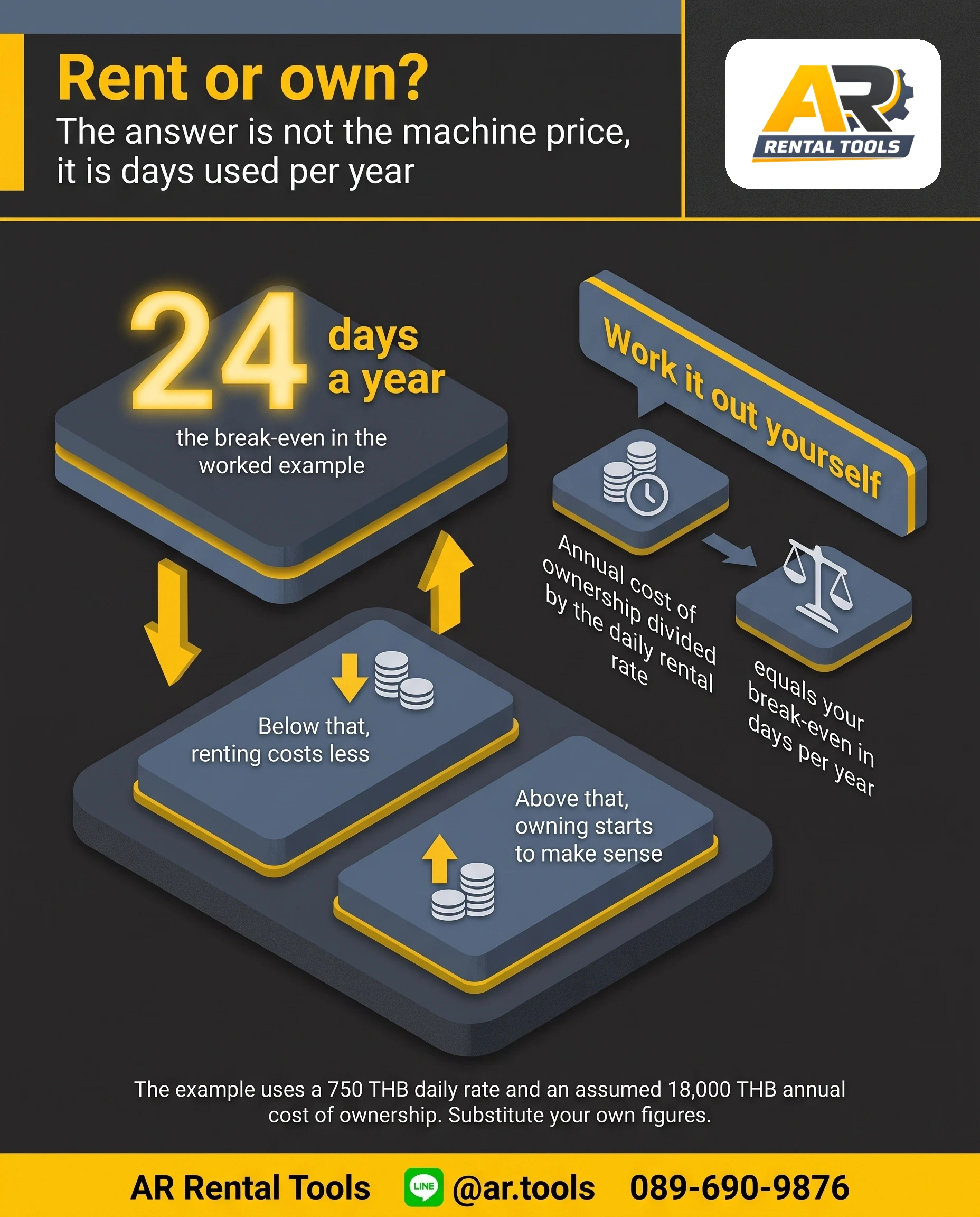
It is one line: divide the annual cost of ownership by the daily rental rate for the equivalent machine. The result is a number of days per year. Below it, renting costs less. Above it, owning starts to make sense.

The annual cost of ownership is the four components above added together: depreciation per year, maintenance per year, storage per year, and an estimate for transport. These are your figures, so use real ones.

The daily rate is available immediately from the equipment and pricing page, for example a petrol plate compactor at 750 THB per day or a concrete mixer at 500 THB per day.

One caveat: you can also rent by the week. If your jobs usually run past 6 days, use the effective daily cost derived from the weekly rate instead, because the weekly rate is 6 times the daily one. That lowers your effective rate and pushes the break-even higher.

A worked example: a plate compactor

Assume a plate compactor at 60,000 THB. That figure is an example for the formula, not a price AR Rental Tools quotes. Substitute the real number you find, then work through it like this.

With 18,000 THB a year established, divide by the 750 THB daily rental rate for a plate compactor. The result is 24 days a year, and that is the break-even for this case.

Read plainly: below 24 days a year, renting costs less and leaves the capital free. Consistently above 24 days a year, owning has a real argument behind it.

What the formula does not yet account for is the capital locked into the machine and unavailable for anything else, and the risk of being down mid-job. Both push the true break-even above 24 days, never below it.

Where owning genuinely makes sense

First, small inexpensive machines used on nearly every job, such as an angle grinder or a general drill. Their annual cost of ownership is tiny, so the break-even is a few days a year, and most people already own them.

Second, machines matched to the work you take repeatedly all year. If you mainly pour slabs and use a concrete mixer on almost every job, your day count clears the break-even without much difficulty.

Third, machines you routinely need with no notice. If your work arrives suddenly and cannot wait for scheduling, immediate availability has genuine value even when the day count sits slightly short of break-even.

In all three cases, do one thing before deciding: count backwards through last year and find how many days you actually used it. Do not go on impression. The feeling of using something often and the real number are usually far apart, and the formula needs the real one.

Where renting still wins, even when you use it often

First, heavy machines needing storage and a large vehicle, such as a walk-behind roller at roughly 600-900 kg. Storage and transport costs here easily swallow the rental difference.

Second, anything billed by the piece where the quantity changes every job, such as steel scaffolding at 10 THB per piece per day. One job needs 20 pieces, the next needs 80; owning enough for the largest job means most of it sits idle most of the year.

Third, machines used only for a short window within a job, even when you take that kind of work often, such as a power screed used only on pour days. Two such jobs a month is still only around 24 days a year.

Fourth, machines where a failure stops the job, because renting includes a replacement you do not have to source yourself. That continuity has real monetary value, and it is why plenty of contractors rent equipment they already own a version of.

Summary, and how to check your own answer

The answer is not the price of the machine, it is the number of days a year you genuinely use it. Divide annual cost of ownership by the daily rate and you have a line you can check.

To test your answer, go back through last year's jobs and count real days. If the number is clearly below break-even, renting is the answer and there is nothing more to think about. If the two are close, take the lower-risk option, which is usually renting.

If it is clearly above break-even, owning is a sound decision, and that is fine. A rental company answering this honestly still does well out of it, because the other machines on the same job remain better rented.

While you decide, get the current rate for whatever you are weighing up. Rates are on the equipment and pricing page, or ask the team via the contact page and put a real number into the formula.

Frequently asked questions

How many days a year do I need to use a machine before owning one makes sense?
There is no single number that works for every machine, so run it yourself: take the annual cost of ownership, which includes depreciation, servicing and upkeep, storage and transport, and divide it by the daily rental rate for the same class of machine. The result is your own break-even in days per year.
What goes into the annual cost of ownership?
Four parts: annual depreciation, which is the machine value divided by the years you expect to get from it; scheduled servicing and upkeep; secure storage that keeps it out of the rain; and transport to each site. All four accrue with time rather than with the number of jobs you take.
Why would a rental company say that owning is sometimes right?
Because that is what the numbers say. A small machine used on nearly every job has a very low cost of ownership, so its break-even sits at only a few days a year. On the same job there are still several machines that come out cheaper rented, so answering straight does not conflict with the service.
For long jobs, should the formula use the daily or the weekly rate?
If your jobs usually run past 6 days at a time, use the per-day average derived from the weekly rate. The weekly rate equals 6 daily rates, so that average is lower and the break-even moves higher than a calculation based on the daily rate alone would suggest.
How do I count my past usage accurately?
Go back over the jobs you actually took in the past year and count only the days that particular machine was in use, not the number of jobs. The feeling of using something often usually runs well above the real figure, and this formula only gives an answer you can trust if the input is the real figure.

Get a quote

For a current daily rate to put into the formula, call 089-690-9876 or message LINE @ar.tools with the machine you are weighing up, and the team will send today's figure straight back.

Back to articles

Content updated: 2026

AR

Ready to start your project?

Talk to our team for a quote and rental details.