
AR Rental Tools
LINE
Rental tips

How Many Days Do You Need a Plate Compactor? Work It Out from Square Metres and Compaction Lifts

September 28, 202611 min read

How Many Days Do You Need a Plate Compactor? Work It Out from Square Metres and Compaction Lifts

How many days of plate compactor rental you need comes from the area, not from how long the crew is on site

How many days you need a plate compactor is a question with only three inputs: the area in square metres, the depth of fill in centimetres, and the daily output of the machine you pick. Most people answer it with the number of days the crew will be on site, which is a different number entirely, and it is why so many bookings get extended halfway through.

The difference matters. A crew on site for ten days does not mean the machine sits there for ten days. Compaction occupies a short window in the earthworks: after filling and levelling are finished, before the blinding goes down. Book the machine for the length of the whole job and the extra rental you pay is the days it stands idle in the yard.

Booking short is expensive in the other direction. Extending mid-job means the machine may already be reserved for someone else, you wait for a truck slot, and the crew you booked loses a day. Getting the number right at booking time beats padding it in either direction.

This article gives you the four-line formula to run before you call, then walks three real jobs from a home driveway to a village road. The rates used throughout are the petrol plate compactor at 750 THB per day and the walk-behind road roller at 1,500 THB per day, as published on the site on the date this went out.
What a compaction lift is, and why 40 cm of fill takes two passes of the whole area

A compaction lift is the thickness of fill you spread once and compact before the next layer goes on top. Vibration from the plate only travels so far into the soil. A typical site machine gets real compaction down to about 20 centimetres. Deeper than that and the soil underneath stays loose even when the surface looks solid.

Compacting one thick layer instead of two thin ones does not show on the day. It shows after the first heavy rain once the slab is down, when the loose material below settles: the floor dips, a long crack opens up, or the edge separates from the ground beam. Breaking out and redoing it costs many times more than one extra day of machine hire.

Counting lifts is simple. Divide total fill depth by 20 centimetres and round up. Twenty centimetres of fill is one lift, forty is two, sixty is three. That single number is why two jobs with the same floor area can take twice as long as each other.

So the working unit in this article is not square metres but square-metre-lifts: area multiplied by lift count. A 300 square metre slab on 40 centimetres of fill is 600 square-metre-lifts of real work, not 300. This is where eyeball estimates go wrong most often.

How Many Days Do You Need a Plate Compactor? Work It Out from Square Metres and Compaction Lifts

The four-line formula that turns square metres into rental days

Line one: get the real area in square metres. Measure width by length of what actually has to be compacted, not the whole plot. If the shape is irregular, cut it into rectangles and add them up. Measuring 5 to 10 percent over is normal and still cheaper than measuring short.

Line two: get the lift count. Divide fill depth by 20 centimetres and round up. Line three: multiply the two together for square-metre-lifts, which is the total distance the machine actually has to cover.

Line four: divide by the daily output of the machine you chose, then round up to whole days. The working mid-points are 400 square-metre-lifts per day for a plate compactor and 1,200 for a walk-behind roller. Where those two numbers come from is the next section.

Written out: area times lifts, divided by daily output, equals rental days. It takes under two minutes on one sheet of paper and gives you a number you can say out loud on the phone: this many days, starting this date.

Plate compactor versus walk-behind roller: square metres covered per day

Daily output is three things multiplied together: the working width of the plate or drum, the speed the machine travels, and how many passes the same spot needs. General fill work takes four passes. Fewer and the soil is not tight enough; more and you stop gaining anything.

A petrol plate compactor weighs 80-100 kg with a 450-550 mm plate. Allow about 10 percent overlap and the effective lane is around 0.45 m. At roughly 15 metres per minute that is 6.7 square metres per minute for one pass, or 1.7 square metres per minute over four passes. Real running time inside an hour is about 40 minutes once you subtract turning, lining up and refuelling, giving roughly 68 square metres an hour, or about 470 square-metre-lifts across a seven-hour day.

The safe planning range is 300-500 square-metre-lifts a day. Open rectangular ground sits at the top of that range; ground full of edges, corners, pile heads, manholes or stub pipes sits at the bottom, because the time goes into lifting the machine around rather than driving it forward. The 400 mid-point is a number you can budget with instead of guessing.

A diesel walk-behind road roller weighs 600-900 kg with a 550-700 mm drum and travels about two and a half times faster. The same arithmetic gives roughly 1,000-1,500 square-metre-lifts a day, with 1,200 as the working mid-point. The trade-off is that nobody wheels it down a narrow lane by hand, it needs vehicle access to the work, and it does not reach corners and edges as well as a plate compactor.

Worked job 1: a 40 square metre home driveway on 20 cm of fill

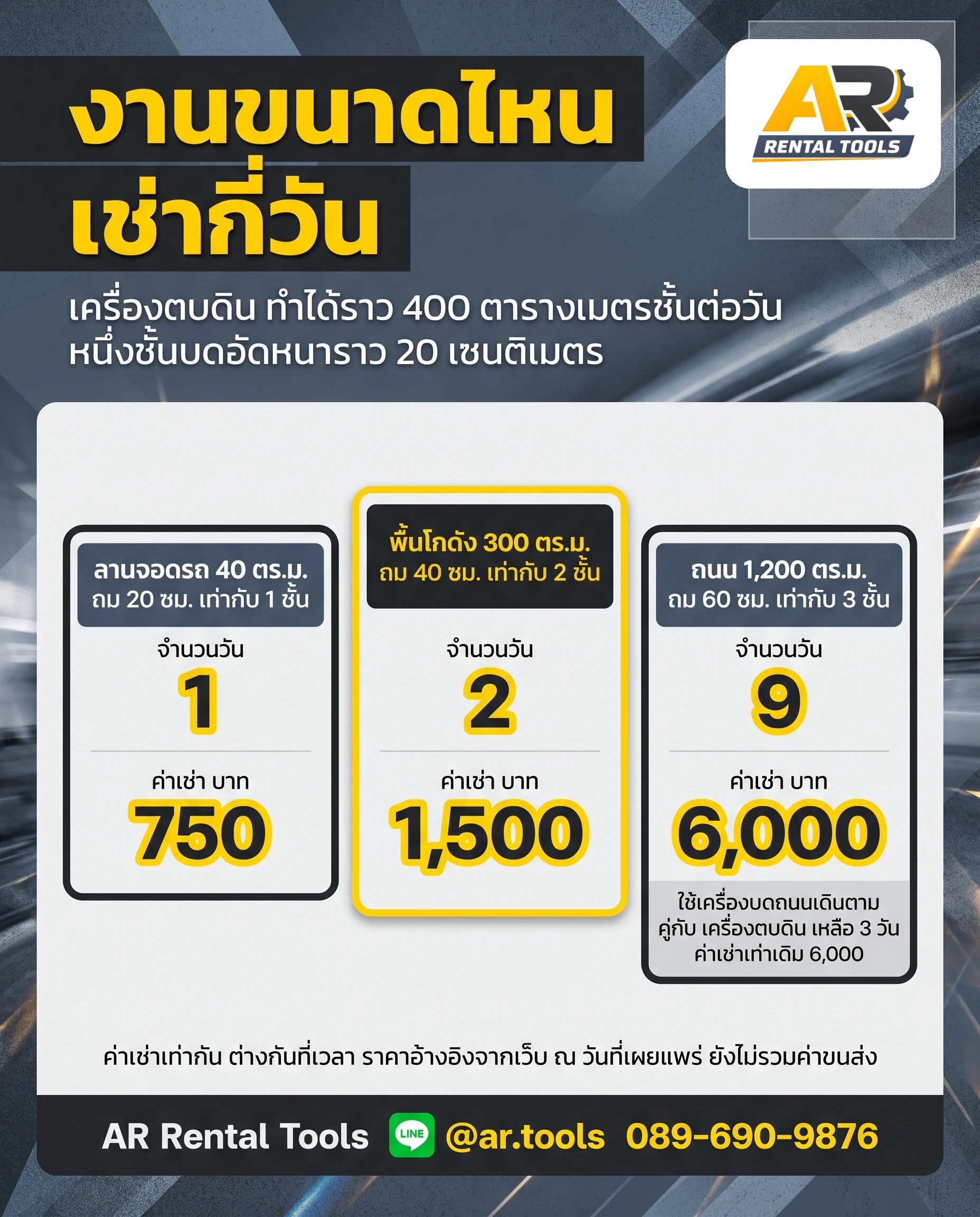
Five metres by eight metres is 40 square metres. Twenty centimetres of fill is one lift, so the real work is 40 square-metre-lifts. Divided by 400 that is 0.1 of a day, rounded up to one. Plate compactor hire: 750 THB.

On a job this size the machine runs for under an hour, so the question to ask is not how many days but what time it arrives and what time it goes back. The rental clock starts on the date the machine reaches site, not the day you start using it. If the truck arrives at three in the afternoon and the ground is not ready, that day is already on the bill.

The cheapest way to run a small job is to have everything finished before the machine arrives: fill spread, levelled with a rake, damped down, and two people standing there. The machine comes off the truck and goes straight to work, finishes inside the morning, and goes back on the afternoon run.

On a job this size the bigger cost is delivery, charged on distance from the branch and piece count. Ask for the all-in figure including transport when you book rather than reading 750 THB off the equipment and pricing page and treating that as the total.

Worked job 2: a 300 square metre warehouse floor on 40 cm of fill

Fifteen metres by twenty is 300 square metres. Forty centimetres of fill divided by 20 gives two lifts, so the real work is 600 square-metre-lifts. Divided by 400 that is 1.5 days, rounded up to two. Two days of plate compactor hire is 1,500 THB.

The common mistake here is reading the job as 300 square metres and concluding one day. That would be right at 20 centimetres of fill, but at 40 the work doubles. Booking one day and extending mid-job puts you at the mercy of whatever the machine is already reserved for.

People often ask whether to take the weekly rate for peace of mind. The straight answer is not yet. The weekly rate of 4,500 THB is six times the daily rate, so a genuine two-day job costs 1,500 THB on daily hire, a third of the price. Weekly only starts winning from day seven onward.

Splitting the two days cleanly helps too. Day one, compact the lower lift across the whole floor, then spread the upper lift late in the afternoon. Day two, compact the upper lift from first thing and send the machine back after lunch. Nothing is standing idle on either day, and with a fixed rate that is the only variable you actually control.

Worked job 3: a 1,200 square metre village road where both answers cost the same and finish six days apart

A road six metres wide and 200 metres long is 1,200 square metres. Sixty centimetres of fill divided by 20 gives three lifts, so the real work is 3,600 square-metre-lifts. At this size the choice of machine finally matters, and the result is not the one people expect.

Option one, plate compactor only: 3,600 divided by 400 is nine days. That prices as one week at 4,500 THB plus two more days at 1,500 THB, so 6,000 THB in total. The upside is that one machine reaches every corner and edge from start to finish with nothing to swap.

Option two, walk-behind roller as the main machine: 3,600 divided by 1,200 is three days at 4,500 THB. Add a plate compactor for the road edges, corners and the ground around manholes, roughly 15 percent of the area, which is 540 square-metre-lifts. Divided by 400 that is 1.4, rounded up to two days at 1,500 THB. Total: 6,000 THB, exactly the same.

The rental cost is 6,000 THB either way, but option one takes nine days and option two takes three. The six-day gap is six days of an operator's wages, six days of barrier and diversion-sign hire, and six days of residents driving on an unfinished road. You have to put your own labour figure in, but once a truck can reach the work the ranking is already clear.

How many days to actually book a plate compactor for, and what to allow on top

The number you calculated is running days, not the number of days to book. The first thing to allow for is rain, because saturated soil will not compact and has to drain first. Between June and October, adding one day to any job that calculates out at three days or more is an allowance that pays for itself.

The second thing to allow for is other people's sequence. Compaction usually waits on the pipe crew or on the last load of fill. If the machine is booked from Monday but the pipes are not in until Tuesday, Monday's hire is gone for nothing. Booking delivery for after the preceding trade genuinely finishes is cheaper than booking early to be safe.

When you call to book, five things let the team answer everything in one call: the area in square metres, the fill depth in centimetres, the site address, the width of the lane entrance, and the date you want the machine there. That is enough to confirm availability, transport and the total.

AR Rental Tools has two branches, Bang Kho Laem and Bang Khen, and delivers to site across Bangkok and the surrounding provinces. The team dispatches from whichever branch is nearer to keep transport down. Contact details are on the contact page, and current rates for everything are on the equipment and pricing page.

Frequently asked questions

How many days of plate compactor rental does 100 square metres need?
It depends on fill depth. At 20 centimetres that is one lift and 100 square-metre-lifts of work, which divided by a daily output of 400 comes to one day. At 40 centimetres that is two lifts and 200 square-metre-lifts, which still finishes inside one day.
What does plate compactor rental cost, and from what point does the weekly rate win?
A petrol plate compactor is 750 THB per day or 4,500 THB per week, which is six times the daily rate. A job running a full six days costs the same either way, and from day seven onward the weekly rate is cheaper. Delivery is charged separately on distance and piece count.
How many square metres can a plate compactor cover in a day?
Roughly 300-500 square metres per day per compaction lift, calculated at four passes per spot across a seven-hour working day. Open rectangular ground reaches the top of that range; ground full of edges, corners and stub pipes lands at the bottom. Budget with the 400 mid-point.
How many passes does 50 centimetres of fill need?
Three, because one compaction lift is about 20 centimetres and 50 divided by 20 is 2.5, rounded up. In practice, split it into three even lifts of about 17 centimetres each rather than leaving a thin final layer, which compacts more evenly.
For road work, plate compactor or walk-behind roller?
If a truck can reach the work, use the roller as the main machine and add a plate compactor for edges and corners. Total hire comes out close to the same but the job finishes about three times faster. In a narrow lane with no vehicle access, the plate compactor on its own is the only option.

Get a quote

To have the team work out the day count from your real job size, call 089-690-9876 or message LINE @ar.tools with the area in square metres and the fill depth, and you will get the day count, the hire cost and the delivery charge back in one conversation.

← Back to articles

Content updated: 2026

AR

Ready to start your project?

Talk to our team for a quote and rental details.