
AR Rental Tools
LINE
Rental tips

Pallet Jack Rental in Bangkok: the Machine Is Rated for 2 Tonnes, the Floor Decides the Rest

November 23, 202610 min read

Pallet Jack Rental in Bangkok: the Machine Is Rated for 2 Tonnes, the Floor Decides the Rest

Pallet Jack Rental in Bangkok: Capacity Is Rarely the Problem, the Floor Usually Is

A pallet jack rental is one of the easier things to arrange and one of the easiest to get wrong, because people check the capacity and stop there. The hand pallet jack on hire here is rated at roughly 2 to 2.5 tonnes, which is well above what most people ever put on one. Capacity is almost never the thing that stops a move.

What stops it is the floor. A pallet jack runs on small hard wheels that carry the entire load through a contact patch the size of a coin. That works beautifully on a smooth continuous slab and fails completely on almost anything else, no matter what the rating plate says.

So the useful question before booking is not how heavy the load is. It is what the whole route looks like from where the pallet sits now to where it has to end up: every threshold, every joint, every change of surface, and every slope along the way.

This guide answers that question. It starts with what is actually on hire, works through what 2 tonnes really moves and the floor conditions that stop the job, then covers getting the forks into the pallet, and ends on the moves that need a different machine. Current details are on the pallet jack page.
What a Hand Pallet Jack Is, and What Is on Hire Here

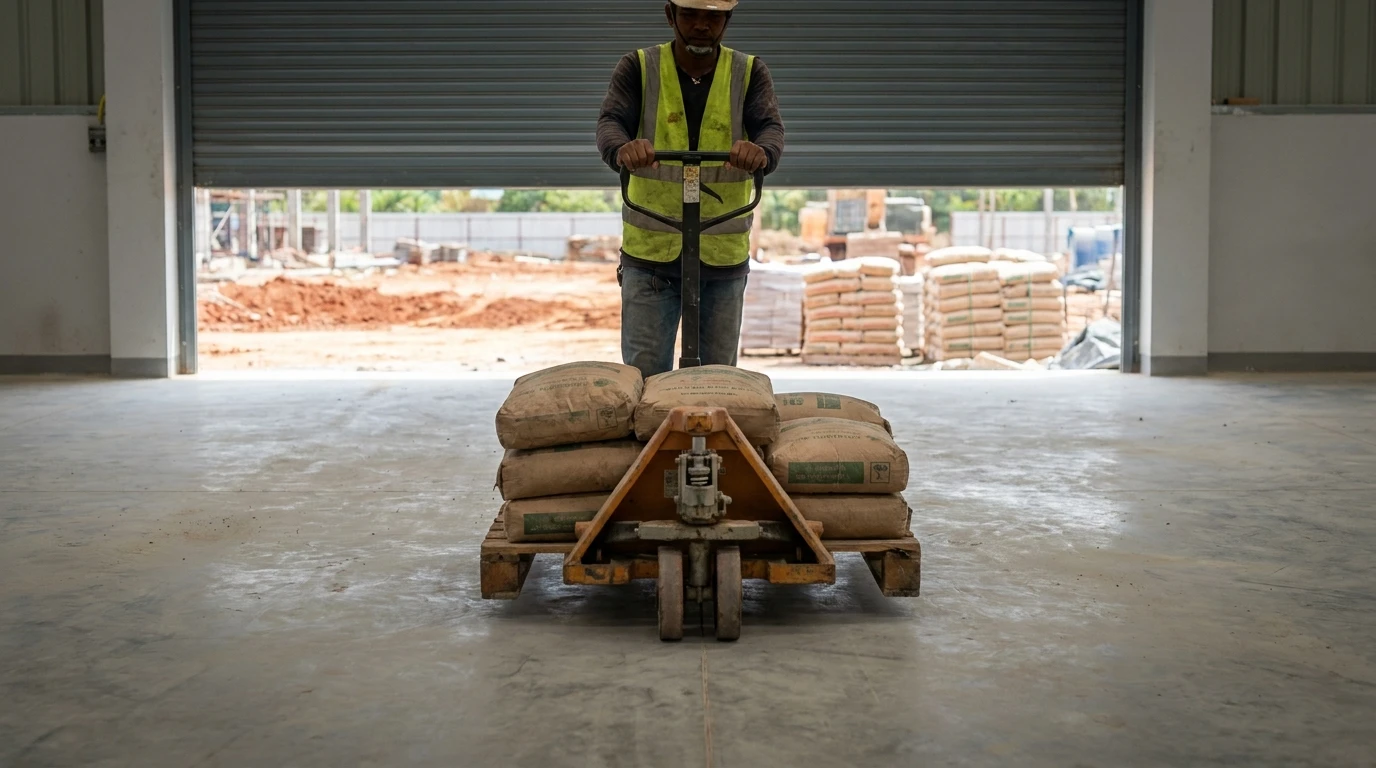
A hand pallet jack is a pair of steel forks on wheels with a hydraulic pump in the handle. You slide the forks into a pallet, pump the handle until the forks lift the pallet clear of the floor by a few centimetres, then pull. It does not carry the load up high; it only lifts it enough to roll.

The unit on hire here is the manual hydraulic type, rated at roughly 2 to 2.5 tonnes and weighing about 50 to 70 kg itself. There is no electric or powered pallet jack on hire. If a job genuinely needs a powered unit, say so when you ring rather than finding out on the day, and the team will tell you straight rather than send the manual one out to fall short.

Manual is the right tool far more often than people expect. On a level warehouse or shop floor one person moves a fully loaded pallet without difficulty, because the hydraulics do the lifting and the wheels do the rest. The effort is in overcoming inertia at the start, not in holding the load.

Where manual genuinely struggles is distance and repetition. Moving one pallet fifteen metres is nothing. Moving forty pallets across a warehouse all day is a different job, and that is the case where a powered unit earns its keep. Judge by the number of moves, not by the weight of one.

Pallet Jack Rental in Bangkok: the Machine Is Rated for 2 Tonnes, the Floor Decides the Rest

What 2 to 2.5 Tonnes Actually Moves

Putting the rating into real loads helps, because two tonnes sounds abstract. A standard pallet of 50 kg cement bags is forty bags at 2,000 kg, which is right at the rating. Most people never stack that high, because the pallet itself and the stack become unstable long before the jack does.

Tile and stone are the loads that surprise people, because they are dense and the stack looks small. A pallet of floor tile can reach a tonne while standing barely knee high. The same applies to a pallet of steel offcuts or a crate of machinery: small footprint, serious weight.

The practical ceiling on a site is therefore set by stability rather than by the rating. A load that is tall, narrow, or unevenly stacked will shift when the wheels cross a joint, and a shifted load on raised forks is how people get hurt. Keep the heavy material low and the stack square before anything moves.

One more figure worth knowing: the jack itself weighs about 50 to 70 kg. Getting it on and off a vehicle is a two-person lift, and it cannot be carried up stairs by one person with a load on it. Plan the unloading point, not just the destination.

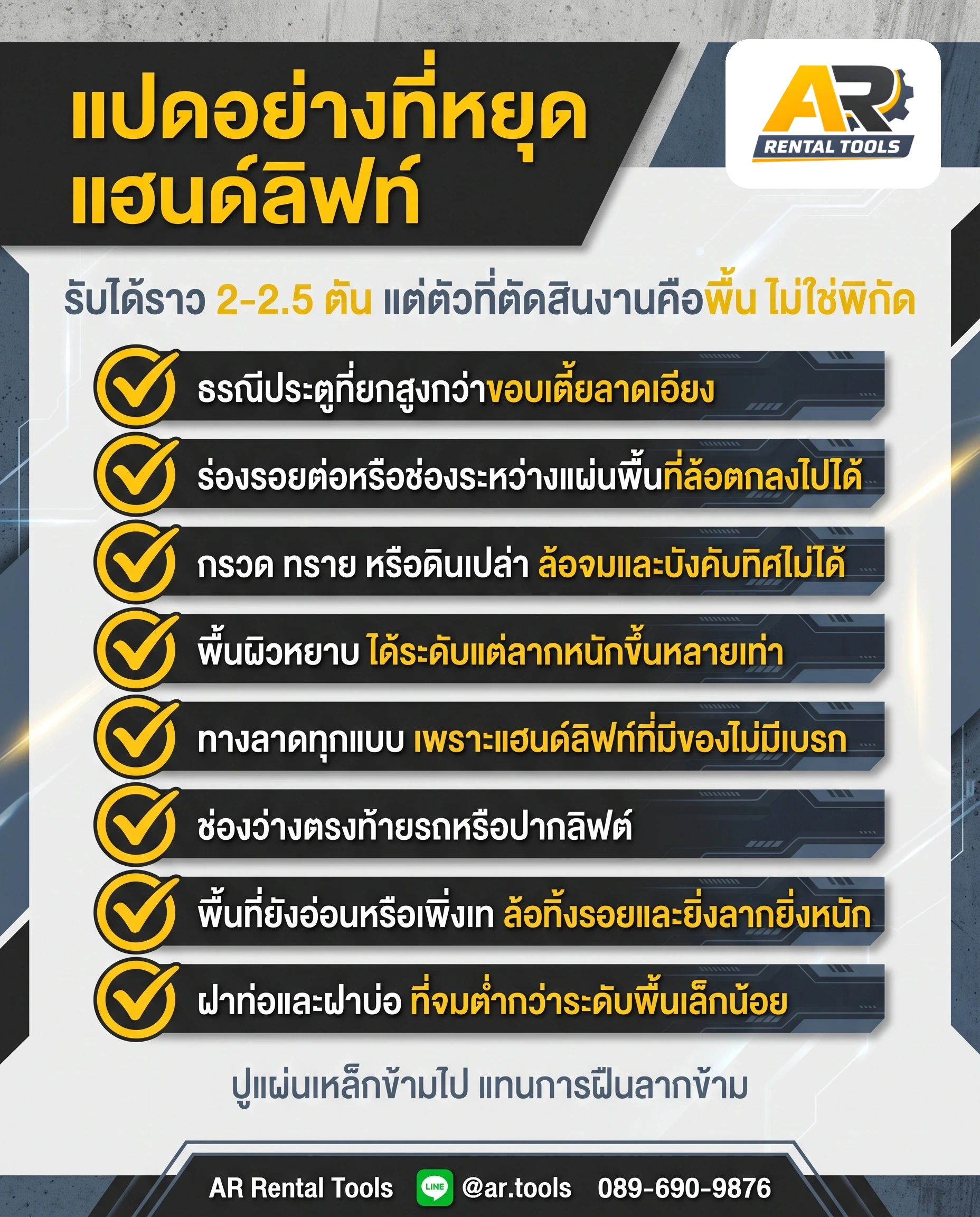
The Floor Is the Real Limit: Eight Things That Stop a Pallet Jack

First, a raised threshold at a doorway. Anything more than a low, chamfered lip stops loaded wheels. Second, an expansion joint or a gap between slabs wide enough for a wheel to drop into, which both stops the jack and can tip the load. Third, gravel, sand or bare earth, where the wheels sink and steering stops working entirely.

Fourth, a floor that is level but rough, such as a broomed or heavily textured slab, which multiplies the effort needed to keep a load rolling. Fifth, any slope at all, covered in its own section below. Sixth, a lift or truck bed with a gap at the edge, where a wheel finds the gap before the operator does.

Seventh, a soft or freshly poured surface, where the wheels leave ruts in the finish and the jack becomes harder to pull the further it goes. Eighth, drains, service covers and inspection hatches, which are usually slightly recessed and catch a wheel exactly when the load is at its heaviest.

Most of these have the same answer, which is to bridge the obstacle rather than fight it. Steel floor plate laid over a joint, a gap or a soft patch gives the wheels a continuous hard surface to cross, and it costs a fraction of the delay caused by a stuck load halfway through a move.

Getting the Forks Into the Pallet

A pallet jack is useless if its forks cannot enter the pallet, and that is decided by the pallet rather than by the jack. Check that the pallet has openings on the side you intend to approach from, because many pallets are only open on two of their four sides and turning a loaded pallet on the floor is not straightforward.

Watch for a closed or fully boarded bottom deck as well. A pallet whose underside is boarded across cannot take forks between the boards, and a load already stacked on one has to be broken down and restacked, which is usually a bigger job than the move itself.

If you are ordering material in on pallets and you already know a pallet jack will move it, say so to whoever is delivering. Asking for open-sided pallets at the point of ordering costs nothing and removes the whole problem. Discovering it when the truck has gone costs the rest of the morning.

When the forks are in, run them all the way to the back of the pallet before pumping. Lifting on the fork tips alone concentrates the load at the end of the forks and makes the pallet tip forward the moment it moves. The forks should support the pallet along their whole length.

Slopes, Gaps and the Things That Actually Go Wrong

A loaded pallet jack has no brake. On level ground that is fine, because it stops when you stop pulling. On a slope it does not: a tonne of material on wheels will keep going, and it will go faster than anyone can walk backwards. Ramps, driveways and any floor built to drain are all slopes.

If a slope cannot be avoided, the load goes down it under control with more than one person, or it does not go down it at all. Never stand downhill of a loaded jack. This is the single most common way people are injured with a machine that looks harmless standing still.

The second common problem is the gap at a truck bed or a lift entrance. A wheel that drops into that gap under load stops the jack instantly and can pitch the stack forward. Bridge it properly with plate every time, even when the gap looks small enough to roll over, because a small gap under a heavy wheel is not small.

The third is the wheels themselves. Small hard wheels find every piece of grit and every stray screw on a floor. Sweeping the route before the first move sounds fussy and saves more time than it costs, because a wheel that jams under load on a tiled floor marks the tile as well as stopping the job.

When a Pallet Jack Is Not the Answer

If the route is not a continuous hard floor, it is not a pallet jack job. Moving material across open ground, a site compound, or anything unsurfaced is a dumper job, or for smaller quantities a wheelbarrow, which handles rough ground without complaint.

If the load has to go up rather than along, that is a different machine again. Vertical movement between floors is mortar hoist work, and lifting a load clear of the floor to place it somewhere is chain hoist work. A pallet jack lifts a few centimetres and nothing more.

If the job is many moves over a long distance, repeated all day, the manual unit will do it but the operator will feel it. That is the genuine case for a powered unit, which is not on hire here. Saying that on the phone is better than sending the manual one and having somebody worn out by lunchtime.

And if the load has no pallet under it at all, the question changes completely. A crate, a machine on feet, or loose material needs either a pallet put under it first or a different approach entirely. Describe what the load is actually sitting on when you ring, because that one detail decides the whole plan.

How to Book and Get It Right the First Time

Four things to give the team: what the load is and roughly what it weighs, what it is sitting on, what the floor is like along the whole route, and whether there is any slope, threshold or gap between the start and the finish. Those four settle whether a pallet jack is the right machine.

If the route has obstacles, ask about steel floor plate at the same time. Bridging a joint or a gap is a small addition to the booking and it is the difference between a move that takes twenty minutes and one that stops halfway. It is much easier to add it to the same delivery than to send a second one.

The weekly rate is six times the daily rate, so from six days of use the weekly rate is the better deal, and shorter jobs are charged by the day as used. Transport is charged separately by distance from the branch and by piece count, and the team confirms it before booking.

There are two branches, Bang Kho Laem and Bang Khen, delivering across Bangkok and the surrounding provinces from whichever is nearer. Everything currently listed is on the equipment list, or contact the team. If you are unsure about the route, photograph the floor along it and send it on LINE; that answers the question faster than describing it.

Frequently asked questions

How much weight can a pallet jack move
The hand pallet jack on hire is rated at roughly 2 to 2.5 tonnes, which is well above most loads people put on one. A standard pallet of forty 50 kg cement bags is 2,000 kg, right at the rating. In practice the limit on site is the stability of the stack rather than the rating of the jack.
Do you have electric pallet jacks
No. Only the manual hydraulic unit is on hire here. Manual is the right tool more often than people expect, because on a level floor one person moves a fully loaded pallet easily. The real case for a powered unit is many moves repeated all day, so tell the team which your job is when you ring.
Can a pallet jack be used outdoors
Only on a continuous hard surface. The wheels are small and hard, so gravel, sand and bare earth stop it entirely, and a rough or textured slab multiplies the effort. For material moving across unsurfaced ground, a dumper or a wheelbarrow is the right machine instead.
What if there is a step or a gap on the route
Bridge it with steel floor plate rather than trying to roll over it. A wheel dropping into an expansion joint or the gap at a truck bed stops the jack instantly and can pitch the stack forward. Plate costs a fraction of the delay from a load stuck halfway through a move, so add it to the same booking.
What should I tell you when I book
Four things: what the load is and roughly what it weighs, what it is sitting on, what the floor is like along the whole route, and whether there is any slope, threshold or gap between start and finish. Those four settle whether a pallet jack suits the job and whether you also need plate.

Get a quote

Tell us the load, what it sits on and what the floor is like along the route, and we will say whether a pallet jack suits it. Call 089-690-9876 or message us on LINE at @ar.tools Photograph the floor along the route and send it over; we reply within business hours.

← Back to articles

Content updated: 2026

AR

Ready to start your project?

Talk to our team for a quote and rental details.