
AR Rental Tools
LINE
Rental tips

Working Down a Narrow Soi in Bangkok: Planning Equipment That Can Actually Reach the Job

September 7, 20269 min read

Working Down a Narrow Soi in Bangkok: Planning Equipment That Can Actually Reach the Job

What a narrow-access site is, and why it changes the whole plan

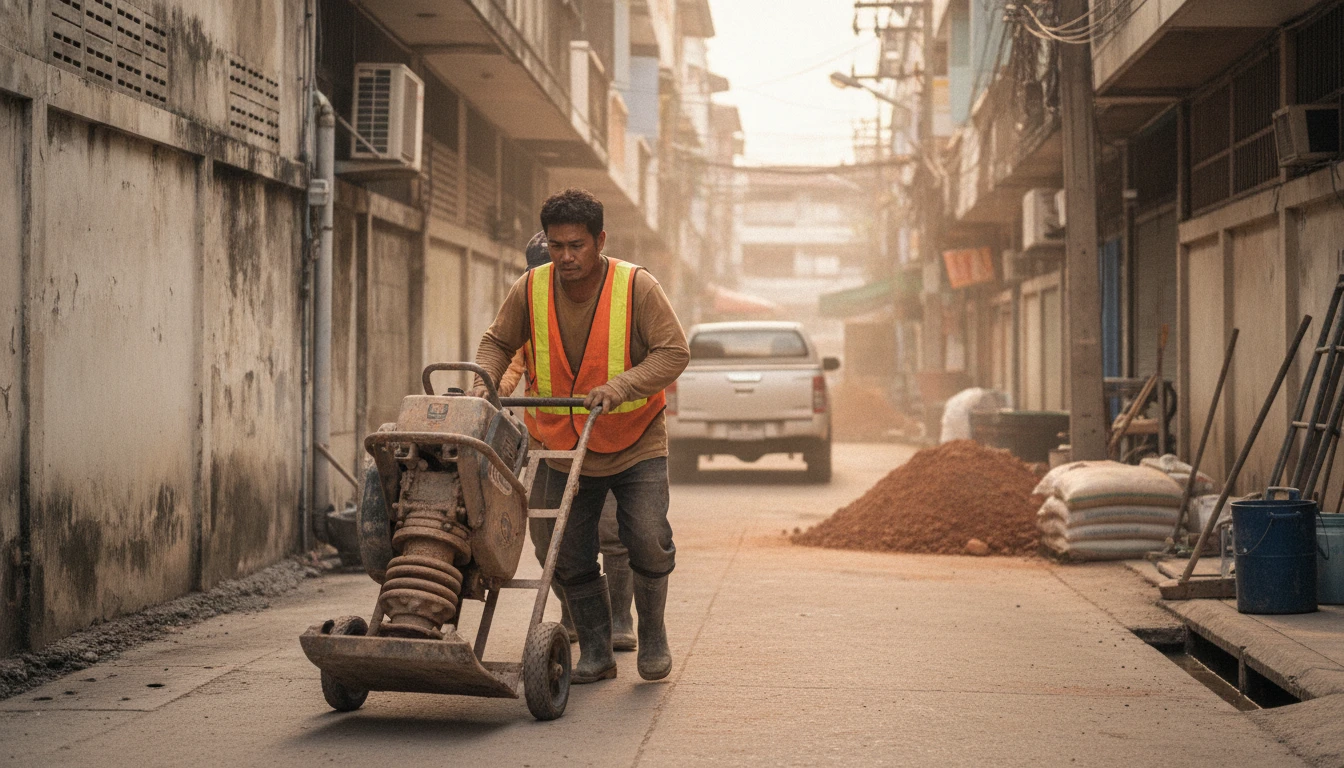
A narrow-access site is one where the delivery vehicle cannot stop at the door. It parks at the mouth of the soi or wherever there is room, and everything is carried in from there. In Bangkok this is not the exception; it is normal for shophouse work, extensions in older estates and inner-city renovations.

What looks like an inconvenience actually reshapes the job. Some machines simply cannot get in, however hard you try, and once that is true the working method changes, which moves the day count, the crew size and the budget together.

The deciding factor is not soi width alone. It is four things together: the narrowest width along the route, the lowest overhead clearance, the distance from parking to the work, and how many steps or level changes there are. Without those four, the odds of equipment arriving and not fitting are high.

The good news is that nearly every job is still doable if you know in advance and pick the right machines. The version that is hard to fix is finding out when the truck is already at the mouth of the soi, because by then you have lost both the trip and the day.
Four measurements to take before booking

First, the narrowest point along the whole route, not the width at the entrance. Most sois pinch somewhere in the middle, and parked motorbikes and cars take more off the usable width. Walk it, measure the tightest point, and write it down in metres.

Second, the lowest overhead clearance. Cables strung across the lane, projecting awnings and the door lintel are the three things that most often stop a vehicle, and the three people most often skip because they look high enough by eye.

Third, the distance from where a vehicle can park to the actual work, in metres. That distance decides how many people and how many trips are needed. Ten metres and fifty metres are completely different jobs once the load is heavy.

Fourth, steps and level changes. A wheeled machine rolls easily over flat ground but has to be lifted at a single step. If there are stairs, note the number of steps and the width of the stairwell as well.

Working Down a Narrow Soi in Bangkok: Planning Equipment That Can Actually Reach the Job

Machine weight decides whether it can be moved in by hand

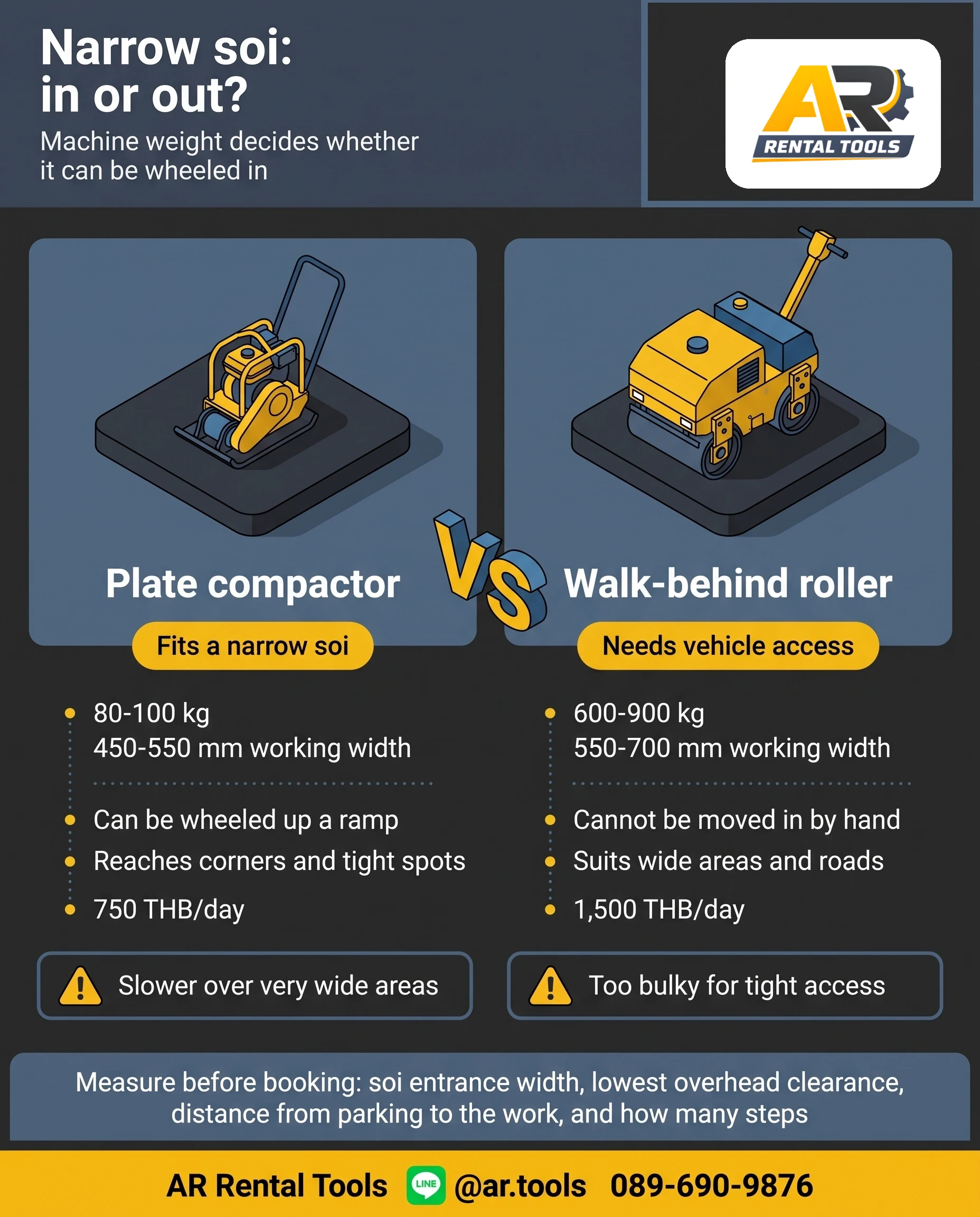
Once a vehicle cannot reach the work, only one question is left: can this machine be moved in by people? The answer is on each item's spec panel as a class-level weight. It is indicative rather than model-specific, but it is enough to decide on.

The group one or two people can carry includes the electric breaker, rotary hammer, welding machine and electric air compressor. Access barely constrains this group at all.

The middle group weighs roughly 50-100 kg and needs two or three people plus a trolley or ramp boards: a concrete mixer at around 50-90 kg and a plate compactor at around 80-100 kg.

The group that cannot get in without vehicle access is the walk-behind roller at roughly 600-900 kg. Nothing at that weight is going down a soi on muscle. If the site is narrow-access, rule it out during planning rather than on delivery day.

Choosing machines that fit without losing the work

The rule that holds most of the time is to drop one size and add a day, rather than forcing the bigger machine in. Compaction down a narrow soi uses a plate compactor at 750 THB per day instead of a roller at 1,500 THB per day, accepting that wide areas go slower.

The arithmetic usually favours it. Compaction the roller would finish in 2 days costs 3,000 THB. The same work with a plate compactor over 3 days costs 2,250 THB, which is 750 THB less, and more importantly it can actually reach the job.

The same applies to cutting. A small concrete saw at 1,000 THB per day is far easier to move than the large unit at 2,000 THB per day. If the required cut depth is within the small machine's range, there is little reason to choose the large one on a narrow-access site.

The exception is downsizing past the point where the work stops being possible. If the slab is thicker than the small saw can handle, choosing it means not getting through and losing the day. Describe the thickness and the work before booking and you will get a straight answer on whether the small unit is enough.

Shophouses and buildings: how things get up, and when you may work

Most shophouse stairs are narrow and steep, so fewer machines can actually be taken upstairs than people expect. Measure the stairwell width and the headroom at the turn, because a machine that fits through the door can still jam at the half-landing.

Where mortar or material has to go up several times a day, compare a mortar hoist at 500 THB per day against the labour of carrying it. This class lifts around 100-200 kg, runs on 220 V, and can be set up in a confined space.

Buildings with a management office add another layer: the hours noisy work is allowed, the hours the service lift may be used for materials, and advance notice requirements. Those rules set how many hours a day you really get, which feeds straight into the day count.

The way to handle it is to get the building's restrictions in full before scheduling, then fix the delivery date. If materials may only move in the morning, an afternoon delivery slot costs a full day while the rental clock runs.

A worked example: a shophouse renovation on a 3-metre soi

A two-storey shophouse renovation. The soi is 3 metres at its widest but has cars parked along it, so the vehicle stops at the entrance, about 40 metres from the front of the building, with two steps at the door. This is the equipment set that actually works, and what it costs.

The compactor line is where the soi changes the plan. This job would normally use the faster roller, but at 600-900 kg it cannot be moved 40 metres by hand, so it becomes a plate compactor at 80-100 kg with one extra day allowed.

The hoist line is a direct consequence of the shophouse. The stairs are narrow and steep, and carrying mortar up to the first floor several times a day costs both effort and time. A week at 3,000 THB is usually less than the labour it replaces.

That 13,630 THB is machine rental only. It excludes blades, fuel, delivery, which on a job like this is usually higher than normal because of piece count and carrying distance, and the labour for moving things in, which is the cost a narrow soi adds specifically.

What to tell us at booking so the right vehicle turns up first time

First, the location down to soi and sub-district, not just the district, so the team can send from whichever branch, Bang Kho Laem or Bang Khen, is closer, and judge what size vehicle can reach you.

Second, say plainly whether a vehicle can reach the door. If it cannot, give the distance from parking to the work in metres. That tells the team how much time to allow for moving equipment and keeps the trip from colliding with another job.

Third, send a photo of the soi entrance and the site on LINE @ar.tools. One photo says more than a long description and shows the cables, the awnings and the tightest point at a glance.

Fourth, flag any time restrictions. If the building or the neighbourhood only allows deliveries in certain hours, say so up front. Call 089-690-9876 or message LINE. The team replies within about 30 minutes during business hours, via the contact page.

Common mistakes, and the summary

The first mistake is measuring at the soi entrance and assuming that is the constraint, when the tightest point is halfway down. Walk the whole route, measure the narrowest point, and note where cars habitually park.

The second is choosing on power alone without checking weight. More powerful machines are generally heavier, and extra power is worthless if the machine cannot get in. Read weight alongside output on the spec panel, every time.

The third is leaving no time in the schedule for moving things in and out. Forty metres of carrying with several items can take an hour at each end. Without that allowance, the first and last days do almost no work.

In short: take the four measurements before booking, read weight alongside power, drop one size and add a day, and send a photo of the soi with your location. Specs and rates are on the equipment and pricing page, or start from the homepage.

Frequently asked questions

How narrow does a soi have to be before a delivery vehicle cannot get in?
There is no single width that answers it, because what matters is the narrowest point, the height of overhead cables and awnings, and the vehicles parked along the way. Measure the tightest point along the whole route and send a photo of the soi entrance, which lets the team judge it far more accurately than a width alone.
What happens if the vehicle cannot reach the work?
The vehicle parks at the nearest point wide enough and the equipment is carried in, which works for most items. Give the carrying distance in metres at booking so the team can allow for the time and the people, and so you can allow for the labour cost of carrying in your own budget.
How heavy can a machine be and still be moved in by hand?
Machines around 50-100 kg such as a concrete mixer or a plate compactor can be moved in by two or three people with a trolley or ramp boards. A walk-behind roller at roughly 600-900 kg cannot be moved by hand at all and needs vehicle access right to the work.
How does mortar get up to the second floor of a shophouse?
If it has to go up several times a day, compare a mortar hoist at 500 THB per day against the labour of carrying it. Hoists in this class lift roughly 100-200 kg, run on 220 V and can be set up in a confined space. For repeated trips to a second floor the hoist usually costs less than the people.
What should I tell you if the site is down a narrow soi?
Give the location down to the soi and sub-district, say whether a vehicle can reach the door, the carrying distance from parking in metres, the number of steps, and any restriction on when materials may be moved. Sending a photo of the soi entrance to LINE @ar.tools is the fastest way.

Get a quote

If your site is down a narrow soi, send a photo of the entrance and your location to LINE 089-690-9876 or call @ar.tools, and the team will tell you what can reach you and which size to take.

Back to articles

Content updated: 2026

AR

Ready to start your project?

Talk to our team for a quote and rental details.