

AR Rental Tools
LINE
Rental tips

Renting a 5,000 VA Generator: What It Actually Runs, and How Many Tools at Once

November 9, 202610 min read

Renting a 5,000 VA Generator: What It Actually Runs, and How Many Tools at Once

Renting a 5,000 VA Generator for a Site With No Power: Start From the Figure You Can Plan With

Hiring a 5,000 VA generator and having it cut out the moment somebody pulls the trigger on a drill is very common, and it is almost never a fault in the generator. It comes from adding tool wattages against the number 5,000, when those two numbers are not in the same unit.

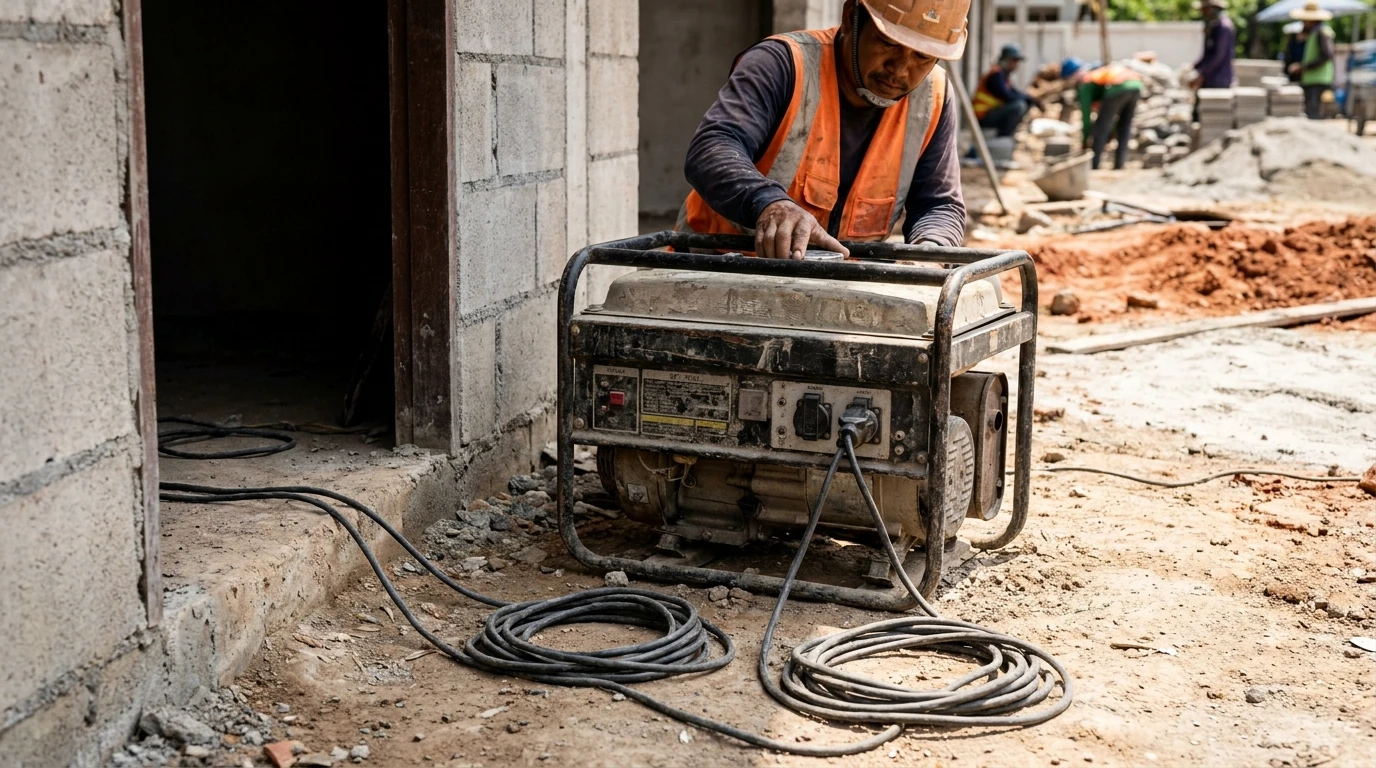
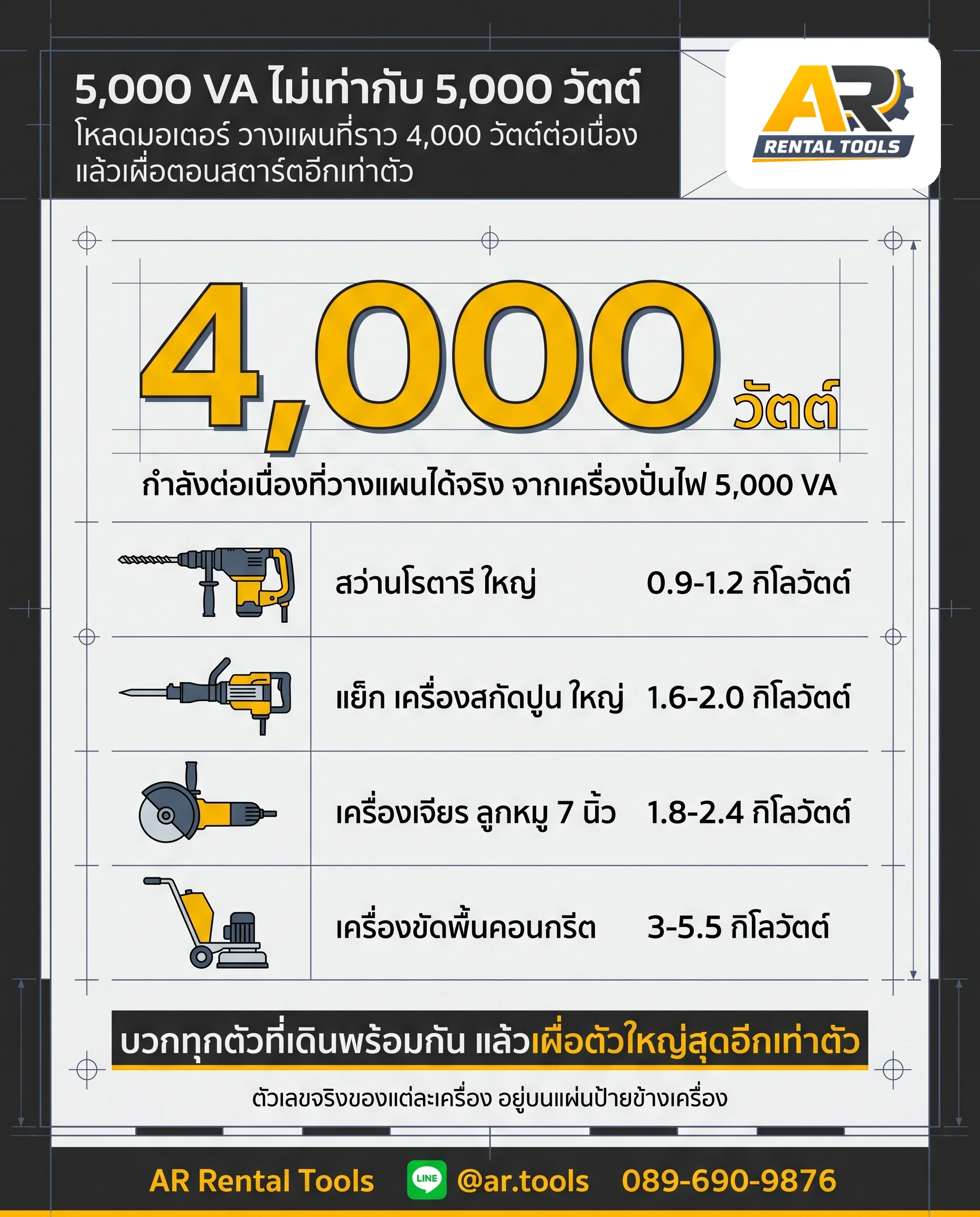
VA and watts are not the same thing. Tools with motors do not draw power as efficiently as a lamp or a heater does, so for a job made up of motors the figure you can actually plan against is around 4,000 watts continuous, not 5,000. The real number for any given tool is on the plate on its side.

The second thing that trips the set is starting surge. A motor coming up to speed draws two to three times its running figure for a fraction of a second. A set of tools that adds up neatly at running draw therefore cuts out the instant somebody hits the switch on the second one.

So this guide works from those two numbers out to the draw of each tool on the list, and then to how many run together. Models and rates are on the 5,000 VA petrol generator page, or see everything on the equipment list.
5,000 VA Is Not 5,000 Watts, and Here Is the Difference

VA stands for volt-amps, and it is the total power a generator can put out. Watts are the power a tool actually turns into work. The two are equal only for a purely resistive load such as a filament lamp or a heater, and there is almost nothing like that on a building site.

Nearly every site tool has a motor, and a motor puts current and voltage out of step with each other. The usable figure is therefore lower than the VA rating, and the multiplier generally used to estimate it is about 0.8. A 5,000 VA set is therefore planned against roughly 4,000 watts continuous.

Even that 4,000 is a ceiling you should not sit against. An engine running at full rating all day gets hot, drinks fuel and wears faster. What crews actually do is plan against roughly eighty percent of the ceiling, which leaves about 3,200 watts for comfortable continuous use.

One line to take to site: a 5,000 VA set plans against roughly 3,200 to 4,000 watts continuous, not 5,000. And that figure still has no allowance in it for starting surge, which is the next section.

Renting a 5,000 VA Generator: What It Actually Runs, and How Many Tools at Once

Starting Surge Is What Cuts the Set Out, Not the Running Draw

A motor standing still needs more to get going than it does once it is turning, because it has to overcome its own inertia. That lasts less than a second, but it pulls two to three times the running figure while it happens, and a generator without enough spare capacity at that moment trips itself out.

So the order you switch things on matters. If two tools add up within rating at running draw, start them one at a time and let the first settle before starting the second. Hitting both switches together means adding both starting figures, which usually goes over rating straight away.

The tools that start hardest here are the ones with a large disc or wheel, because there is rotating mass to bring up to speed. Percussive tools such as drills and breakers start more gently for their size, but draw steadily the whole time they are working.

The simplest way to allow for it: find the highest-rated tool in the set, and add its figure again on top of the running total. If that number is still inside rating, the set will run together.

What Each Tool on the List Draws

The lightest group sits at a kilowatt or under: the small drill at roughly 0.7 to 0.9 kW, and the 4 inch angle grinder at roughly 0.8 to 1.1 kW. These run comfortably, and several of them genuinely do run at the same time.

The middle group runs from one to two kilowatts: the large rotary hammer at roughly 0.9 to 1.2 kW, the mortar vibrator at roughly 1.0 to 1.5 kW, the mortar hoist at roughly 1 to 2 kW, the electric air compressor at roughly 1.5 to 2.2 kW, and the large electric breaker at roughly 1.6 to 2.0 kW.

The heavy group starts at the 7 inch angle grinder at roughly 1.8 to 2.4 kW, which is more than half the planned capacity on its own, and ends at the concrete floor grinder at roughly 3 to 5.5 kW, the one machine that takes this whole generator or more.

Welding machines are a special case that cannot be reckoned in kilowatts, because they are rated by welding current. The small welding machine runs at roughly 100 to 200 A on 220 V, and the large one at roughly 200 to 400 A takes either 220 or 380 V. The figure to confirm before booking is the voltage the machine is set for, which is covered in section six.

How Many Run Together: Three Sets Worked Through

The first set is general installation work: one large rotary hammer at roughly 1.2 kW, one 4 inch grinder at roughly 1.1 kW, and lighting plus chargers at roughly 0.3 kW. Running total about 2.6 kW. Allow the largest tool's figure again, about 1.2, and you reach 3.8, which is still inside rating. That set runs together.

The second set is demolition: one large breaker at roughly 2.0 kW and one 7 inch grinder at roughly 2.4 kW. Running total about 4.4 kW, which is already over the planned ceiling before any allowance for starting at all. That set has to be run one tool at a time, or it needs a second generator.

The third set is a pour: one mortar vibrator at roughly 1.5 kW, one mortar mixer, and lighting. The running total is still in the low three kilowatts, and it stays inside rating with the starting allowance added. That set runs together, though the tools should still be started one at a time with the first left to settle.

The pattern across all three is straightforward. One 5,000 VA generator carries two mid-size tools together comfortably, carries one large tool, and does not carry two large tools at once. Give the whole tool list when you ring and the team can work it out before you book.

What This Generator Cannot Run, and Why

The first case is the concrete floor grinder at roughly 3 to 5.5 kW. The bottom of that range will just run on its own with nothing left over for anything else; the top of it is already past the planned capacity. Floor grinding wants real site power rather than this generator. If the site has no power at all, say so when you ring.

The second case is anything needing 380 V. This generator supplies 220 V. The large welding machine takes either 220 or 380 V, so the voltage the unit going out is set for has to be confirmed first, because a machine set to 380 V will not work at all on a 220 V generator.

The third case is not about capacity but about how the load behaves. Welding draws in bursts and draws hard at the moment the arc strikes. If you are going to weld off generator power, give the generator that one machine to feed and do not split its output with other tools at the same time.

The last case is anything sensitive to power quality, such as electronics and some chargers. Generator output is not as smooth as mains. Put that group behind protection or run it from another source. Motor-driven site tools have no problem with it.

Fuel, Cable and the Safety Points People Skip

First and most important: a petrol generator goes outdoors, or somewhere with genuinely full air movement, and nowhere else. The exhaust contains carbon monoxide, which has no colour and no smell. Putting one in a room, in a garage with the door down, or under a building where air does not move, is lethal, and it happens faster than people expect.

Second is cable. A long run drops voltage along its length, and a motor fed under voltage runs hot and works harder than it should. If the run has to be long, use a larger cross-section cable, and always unwind a reel completely, because cable still coiled up builds heat inside itself.

Third is fuel. The engine gets shut down and allowed to cool before every refill, with no exceptions, and spare fuel gets kept well away from the set. How much it uses in a day depends on the load it is actually carrying: a set running near full rating all day gets through noticeably more than one running at half.

Fourth is siting. Put it on level dry ground, never anywhere water pools, and leave clearance all round so it can shed heat. At roughly 60 to 90 kg it is a two-person lift on and off a vehicle, not a one-person job.

How to Book and Have Enough Capacity on Day One

Three things to give the team when you ring: the full list of tools going on the generator, how many of them will genuinely run at the same time, and the distance from where the set will stand to the furthest working point. That is enough to work out whether one set covers it or you need two.

If there is a welding machine on the list, say whether it is the small or the large one, and for the large one confirm the voltage it will be set for. If there is a floor grinder on the list, say up front whether the site has power, because those two items change the whole answer.

The weekly rate is six times the daily rate, so from six days of use the weekly rate is the better deal and shorter jobs are charged by the day as used. Transport is charged separately by distance from the branch and by piece count, and the team confirms it before booking.

There are two branches, Bang Kho Laem and Bang Khen, delivering across Bangkok and the surrounding provinces from whichever is nearer. If you are not sure the capacity is there, photograph the rating plate on the tools you plan to use and send it on LINE; the team can read the figures and do the arithmetic. Or contact the team directly.

Frequently asked questions

What can a 5,000 VA generator run
Plan against roughly 3,200 to 4,000 watts continuous, which covers two mid-size tools at the same time, such as a large rotary hammer at about 1.2 kW alongside a 4 inch grinder at about 1.1 kW plus lighting. It is not enough for two large tools running together.
How many watts is 5,000 VA
Not a direct conversion. VA is the total power the set can put out; watts are what a tool turns into work. They match only on a purely resistive load. Motor-driven tools use roughly 0.8 of the rating, so a 5,000 VA set plans against about 4,000 watts continuous.
Why does it cut out when I switch on the second tool
Because a motor's starting surge runs two to three times its running draw for a fraction of a second. A set that added up neatly at running draw goes over rating the instant a second tool starts. Start them one at a time, let the first settle, and allow the largest tool's figure again on top.
Can it run a concrete floor grinder
Not recommended. The floor grinder sits at roughly 3 to 5.5 kW. The bottom of that range will just run alone with nothing left over; the top is past the planned capacity. Floor grinding wants real site power. If the site has no power at all, tell the team when you ring.
Can I put the generator indoors
No. A petrol generator goes outdoors or somewhere with genuinely full air movement, and nowhere else. Its exhaust contains carbon monoxide, which has no colour and no smell. In a closed room, a garage with the door down, or under a building where air does not move, it is lethal, and faster than people expect.

Get a quote

Give us the tool list and how many run at once, and the team will work out whether one set covers it. Call 089-690-9876 or message us on LINE at @ar.tools Photograph the rating plates and send them over; we reply within business hours.

← Back to articles

Content updated: 2026

AR

Ready to start your project?

Talk to our team for a quote and rental details.