
AR Rental Tools
LINE
Rental tips

Budgeting the Equipment Line in Your Quotation: What It Really Costs to Rent in Bangkok

August 31, 20269 min read

Budgeting the Equipment Line in Your Quotation: What It Really Costs to Rent in Bangkok

What the equipment budget is, and why contractors get it wrong

The equipment budget is money you commit to in a quotation before you know whether the job is yours. Put too little in and the profit you planned disappears into a few extra rental days. Put too much in and you lose the job on price. The goal is accuracy, not padding.

The mistake is rarely the rates themselves, since those are published. It is counting the wrong number of days, and assuming the rental line contains only the machine. Delivery, consumables and the days a machine sits idle on site all arrive later.

A safer method is to split the line into four parts from the start: machine rental, delivery in and out, consumables that get used up, and the deposit you pay in advance. Each behaves differently, so they cannot be estimated as one number.

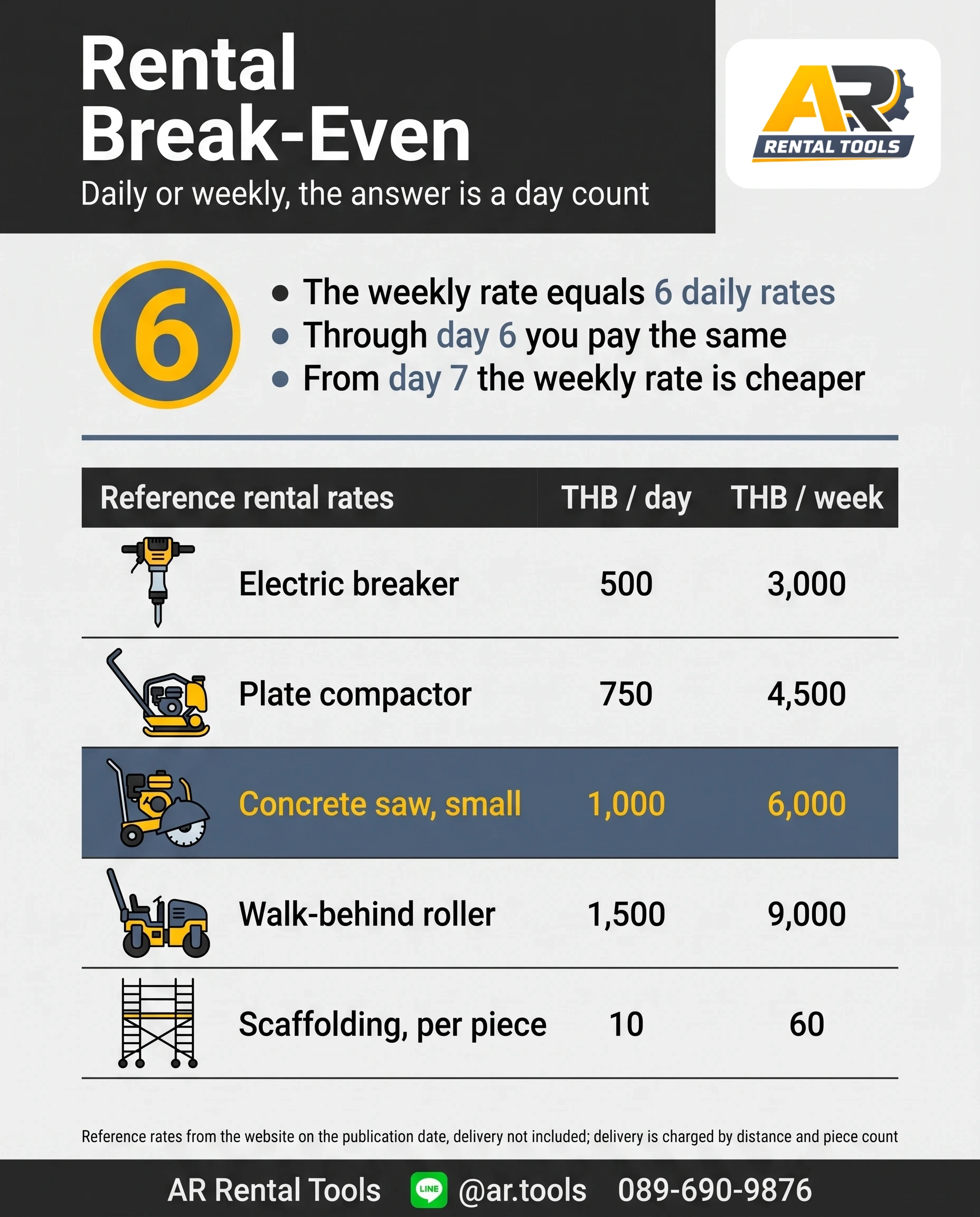
One figure changes how you plan everything else. At AR Rental Tools the weekly rate is 6 times the daily rate on every item, which means every machine in the fleet has its break-even on the same day.
The four parts: rental, delivery, consumables, deposit

Machine rental is the most predictable part because the rates are published. An electric breaker is 500 THB per day or 3,000 per week, and a petrol plate compactor is 750 per day or 4,500 per week. The full list is on the equipment and pricing page.

Delivery has no fixed price. It is charged by distance from the branch and by piece count, so a job near Bang Kho Laem or Bang Khen and a job out in the surrounding provinces produce different numbers. Ask before you write it into a quotation.

Consumables are the things used up during the work and not included in the machine rate. The most common is the cutting blade on a concrete saw, which is billed separately, along with fuel for petrol and diesel machines that the site fills itself.

The deposit is not a cost, because it comes back when the equipment is returned complete and undamaged. It is cash leaving your hands early, so it belongs in your cash-flow planning as its own line rather than being folded into the rental figure.

Budgeting the Equipment Line in Your Quotation: What It Really Costs to Rent in Bangkok

Count rental days properly: working days are not rental days

The quietest profit leak is multiplying working days by the daily rate. Equipment is always on site longer than you use it, because the truck arrives before work starts and collects after it finishes.

Count from the day the machine arrives to the day it is collected, not the days a worker had his hands on it. Three days of actual work, with an evening delivery the day before and a morning collection the day after, becomes five days on the bill very easily.

The same applies to holidays and rained-off days. If work stops but the machine is still on site, that day is still a rental day. The fix is to schedule delivery and collection tight against real working days, and to state your intended return date when you book.

Staggering also works. A breaker needed only at the start does not have to sit on site until the job ends. Return what is finished, then take the next machine, and the idle days disappear from the bill.

Daily or weekly: the break-even is always day 6

AR Rental Tools uses one rate structure across the fleet: the weekly rate is 6 times the daily rate. A breaker at 500 per day is 3,000 per week, a plate compactor at 750 per day is 4,500 per week, and scaffolding at 10 per piece per day is 60 per piece per week.

Because the ratio is constant, the break-even lands on the same day for every item regardless of price. Five days is cheaper daily, six days costs exactly the same either way, and from day 7 onward the weekly rate always wins.

In real numbers, a small concrete saw for 7 days is 1,000 times 7, or 7,000 THB daily, against 6,000 THB weekly, a difference of 1,000 THB. Forty pieces of scaffolding for 7 days is 2,800 THB daily against 2,400 THB weekly.

When budgeting, ask one question per line: will this machine be on site for more than 6 days? If yes, price it on the weekly base from the start. If no, price it daily and carry the risk of the job running long as a separate line rather than inside the rate.

A worked example: breaking out and repouring a car-park slab

Take a job breaking out an old car-park slab and repouring it, estimated at 8 working days, using six machines that each stay on site for a different length of time. Laid out line by line, it looks like this.

The concrete mixer line is where the break-even shows. It has to stay all 8 days. Priced daily that is 500 times 8, or 4,000 THB; priced as one week plus one day it is 3,500 THB, saving 500 THB on a single line.

That 10,000 THB is machine rental only. It excludes the cutting blade for the saw, which is billed separately, delivery in and out, and the deposit. All three need a phone call to confirm before the quotation goes out, because guessing costs you in both directions.

To get the numbers quickly, send the equipment list, start date, return date and site location in one message. The team can then come back with delivery cost and truck scheduling in a single round rather than several.

The costs people leave out, and only notice after the job

Consumables are forgotten most often. A concrete saw's cutting blade is billed separately from the machine, and blade life depends on the thickness and hardness of what is being cut, so slab work consumes far more blade than shallow pipe trenching.

Fuel is the next. Petrol and diesel machines such as plate compactors and walk-behind rollers are fuelled on site by the renter. Electric machines have no fuel cost but need adequate supply, and where the site is short of power a generator becomes another line.

Labour for loading and carrying is a genuine cost. Several machines are too heavy for one person, and a site the truck cannot reach needs people to carry equipment in. That time is paid for but produces nothing on the job itself.

Finally, loss and damage. Anything returned incomplete or damaged affects the deposit. The most reliable protection is to inspect and photograph at handover and again at return, so both sides have the same record.

Getting confirmed numbers before the quotation goes out

First, lay out the programme and write a separate start and return date for each machine. Do not treat the equipment as one block for the whole job, because the machines are never on site for the same length of time.

Second, compare daily against weekly on every line expected to exceed 6 days and take the cheaper base. This takes under five minutes and routinely removes hundreds to low thousands of baht from the total.

Third, call 089-690-9876 or message LINE @ar.tools with the list, the dates and the site location to confirm rates, delivery, deposit and truck availability. The team replies within about 30 minutes during business hours, Monday to Saturday, 08:00 to 17:00.

Fourth, put the confirmed figures into the quotation and keep the overrun risk as its own visible line rather than hidden inside the rate. If the job does run long, you can then explain the difference with numbers the client can check. Reach the team via the contact page.

Common mistakes, and a checklist before you quote

The first mistake is pricing the equipment as one block. Multiplying the full project duration by every machine inflates the total and loses the job, when in reality several machines are needed for only a day or two.

The second is discovering delivery at billing time. Because it is charged by distance and piece count, a distant site or a large load can differ substantially from a guess. Ask first and enter a real figure.

The third is using daily rates on a job that runs past 6 days. That is money given away for nothing, since switching the base to weekly costs no change to the programme at all.

In short: split the four parts, count from delivery to collection, check the day-6 break-even on every line, and confirm delivery and deposit before you quote. Rates are on the equipment and pricing page, or start from the homepage.

Frequently asked questions

What percentage of a job should equipment rental be?
There is no percentage that works across jobs, because the share depends on how equipment-heavy the work is and how long it runs. It is more reliable to list each machine, multiply the real rate by the days it will be on site, then add delivery and consumables. That produces a figure the client can check.
Is daily or weekly rental better value?
At AR Rental Tools the weekly rate is 6 times the daily rate on every item. Up to 5 days, daily is cheaper. At exactly 6 days the two cost the same. From day 7 onward the weekly rate is always cheaper, so check every line you expect to run past 6 days.
How is delivery charged? Is there a fixed price?
Delivery is charged by distance from the branch and by the number of pieces carried, so there is no fixed published rate. Send the site location along with the equipment list and the team will confirm the delivery charge and truck scheduling before you commit, so the quotation carries a real number.
Does the deposit count as a job cost?
The deposit is not a job cost, because it is returned once the equipment comes back complete and undamaged. It is cash paid out early, so it belongs in cash-flow planning as its own line rather than inside the rental figure. Deposit amounts vary by item, so confirm at booking.
What information do you need to quote?
Send the equipment you need, the start date, the return date and the site location together in one message. Call 089-690-9876 or message LINE @ar.tools. The team replies within about 30 minutes during business hours and confirms rates, delivery, deposit and truck scheduling in one round.

Get a quote

To get rental, delivery and scheduling figures for your quotation, call 089-690-9876 or message LINE @ar.tools. Include your start and return dates and the team can confirm the cheaper rate base in one round.

Back to articles

Content updated: 2026

AR

Ready to start your project?

Talk to our team for a quote and rental details.