

AR Rental Tools
LINE
Rental tips

A Concrete Mixer Is Not Ready-Mix: How Small the Pour Has to Be to Mix It Yourself

November 16, 202610 min read

A Concrete Mixer Is Not Ready-Mix: How Small the Pour Has to Be to Mix It Yourself

If You Searched for a Ready-Mix Truck to Hire and Landed on the Concrete Mixer Page

A concrete mixer and ready-mix concrete are two different things, and a good number of people reach this shop's mixer page by searching for a ready-mix truck to hire, which is not what is on offer here. So it is worth answering plainly in the first line, before anybody wastes time.

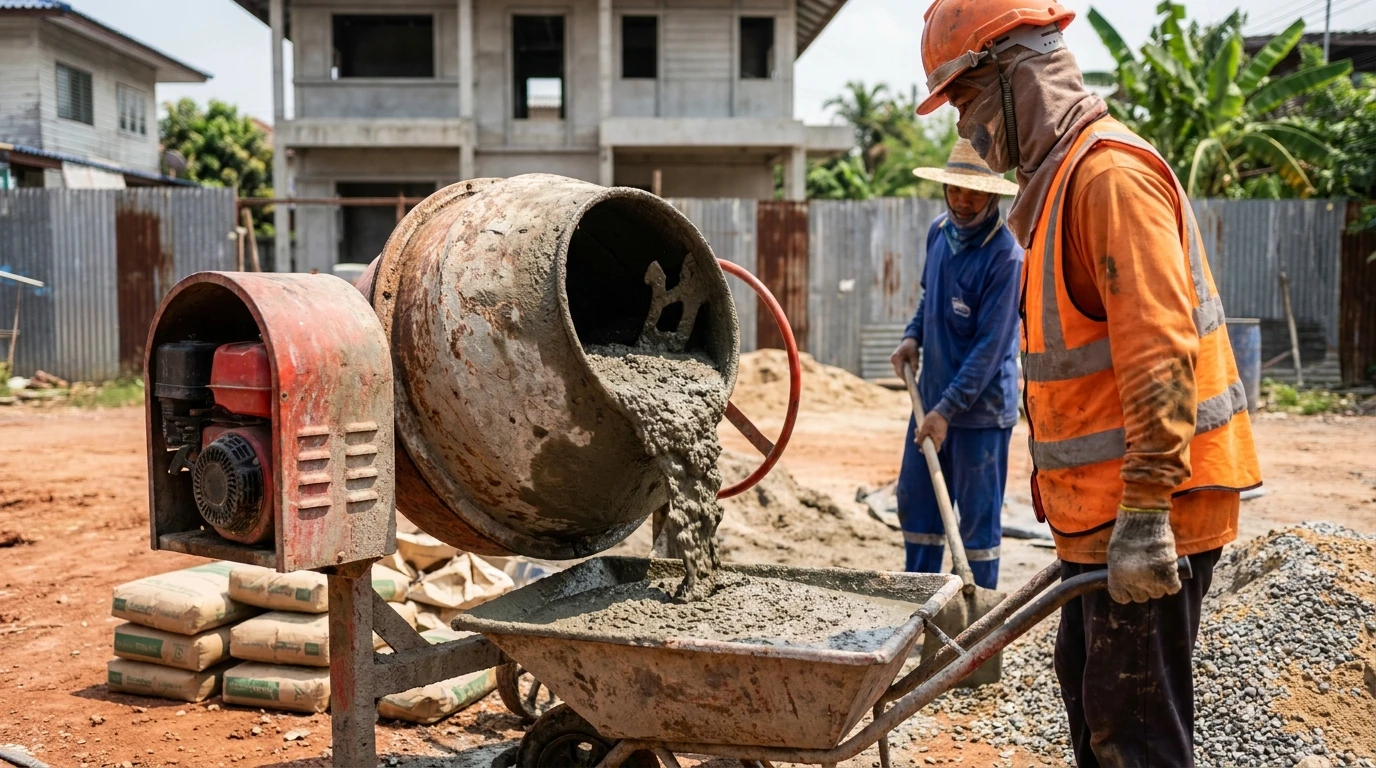
What is on hire is a concrete mixer: a machine that stands in one place on site, into which you load cement, aggregate, sand and water yourself, and which turns its drum to mix them. Ready-mix concrete is the material itself, batched at a plant and delivered in a rotating truck. That is a concrete plant's product and service, not a piece of hire equipment.

To put it as directly as possible: there are no ready-mix trucks on hire here, and this is not a concrete supplier. If the job genuinely needs ready-mix, it has to be ordered from a concrete plant directly. What this shop can help with is the equipment the pour itself needs, which is section six.

The question worth asking next is whether your job is small enough to mix on site. This guide answers it with real figures, starting from what one load of the concrete mixer actually yields, and ending on a dividing line most people think is about money when it is really about cold joints.
How the Two Differ, and What Is Actually on Hire

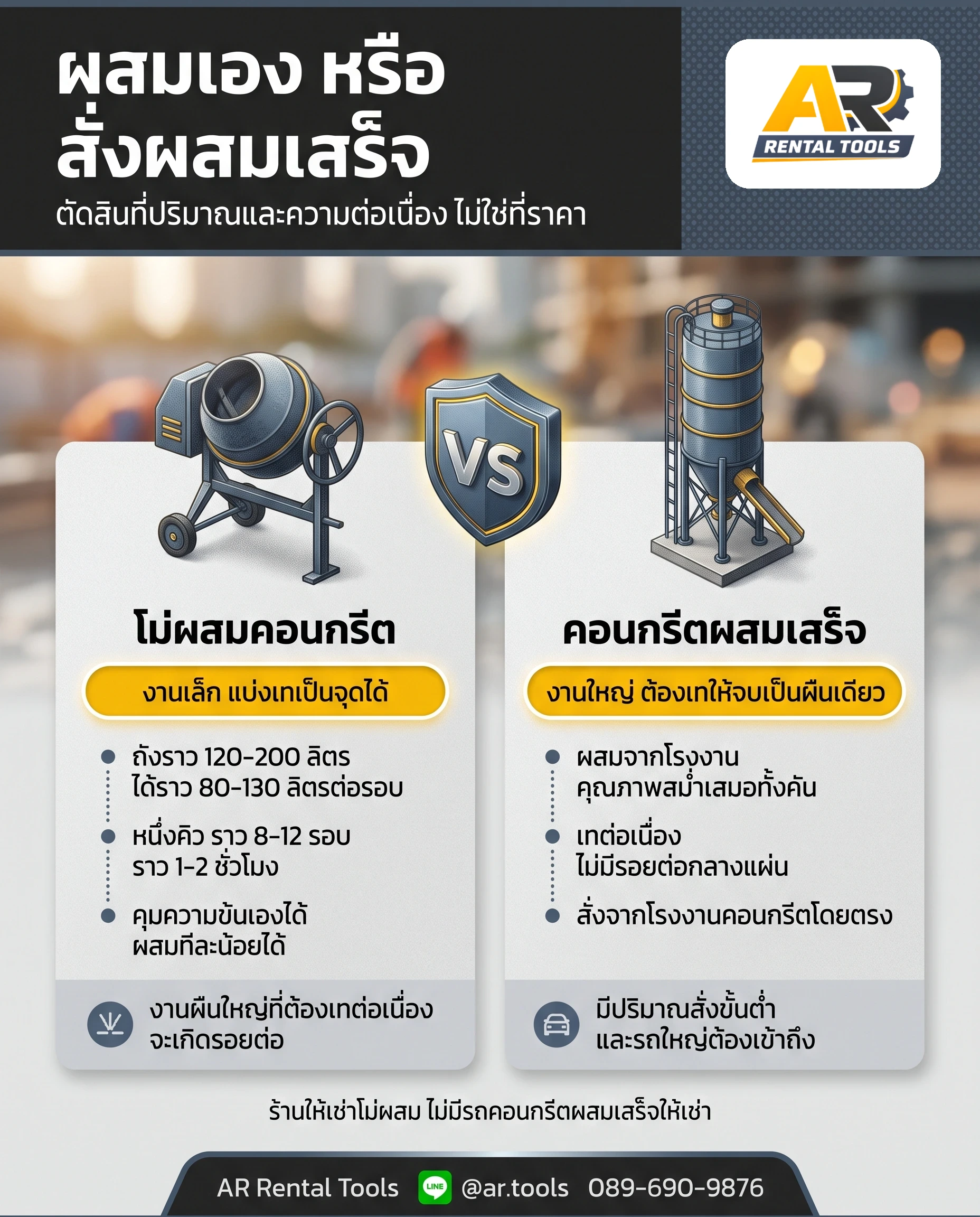
The concrete mixer is a tool. It has a tilting rotating drum of roughly 120 to 200 litres, driven by a petrol engine or a 220 V electric motor depending on the model, weighing roughly 50 to 90 kg, and measuring about 150 by 90 by 140 cm. Wherever you stand it is where it mixes.

Ready-mix concrete is a material. A plant batches it to a stated strength and sends it out in a truck whose drum turns the whole way. The advantage is consistent quality across the load and a continuous pour in one go. The limits are a minimum order, an access route a large truck can actually use, and being genuinely ready to pour when it arrives.

So the easiest dividing line is volume and continuity. Small volume, poured in separate pieces with no need for continuity, on a site a large truck cannot reach: that is mixer work. Large volume that has to finish as one unbroken slab: that is ready-mix work.

What is on hire here in this group is the concrete mixer, the mortar vibrator for driving air out of the placed concrete, and the wheelbarrow and dumper for moving it. All of those are just as useful on a pour where the concrete was ordered in.

A Concrete Mixer Is Not Ready-Mix: How Small the Pour Has to Be to Mix It Yourself

What One Load Yields, and How Many Loads a Cubic Metre Takes

The first figure to understand is that drum capacity is not the same as batch yield. The drum needs room for the mix to tumble as it turns; fill it to the brim and it will neither combine properly nor stay inside. A drum of roughly 120 to 200 litres therefore yields about 80 to 130 litres of mixed concrete per load, depending on the model and how stiff the mix is.

The second figure is cycle time. A full cycle, from loading the materials through mixing to discharging, runs roughly five to ten minutes with somebody feeding it steadily. With fewer hands, or with the materials stockpiled any distance away, the cycle stretches immediately.

Multiply the two. A cubic metre is 1,000 litres, and at roughly 80 to 130 litres a load that is about eight to twelve loads, or roughly one to two hours with the crew ready to feed it. That is for one cubic metre.

Put a real job in. A slab 4 by 5 metres at 10 cm thick is 2 cubic metres, which is roughly sixteen to twenty-five loads, most of a day with a small crew. A job wanting five cubic metres or more jumps to forty or sixty loads, which is the point at which the plan deserves another look.

The Real Dividing Line Is Not Money, It Is the Cold Joint

Most people compare the two options on cost, when the more important reason is the concrete itself. Concrete begins to set not long after it is mixed. If the first load goes down and the next arrives too late behind it, the two do not knit into one body, and you get a joint through the slab.

That joint is not just a surface mark. It is a plane weaker than the material around it, running the full thickness. A slab with several such planes scattered through it cracks along them under load, or when it expands and contracts with temperature, and that is much harder to put right afterwards than it is to plan around at the start.

This is why a large slab, a beam, or a column that has to be poured continuously is not mixer work no matter how much time you have. Not because a mixer cannot produce the volume, but because producing it in loads gives a different result from placing it in one go.

The reverse also holds. Work that can be split into separate pieces without harm, such as fence post bases one at a time, small pier footings, a path with movement joints already designed into it, or patching a surface here and there, suits a mixer well and carries no cold joint penalty at all, because the joints are where somebody meant them to be.

The Jobs a Mixer Genuinely Suits

The first group is work totalling up to around two cubic metres that can be split: a fence line of ten to twenty posts, several poured per day, each already a separate block. The loads spread across days and nobody is racing anything.

The second is anywhere a large truck cannot get to: tight lanes, houses down an alley, buildings where material has to come through a narrow passage, or work on an upper floor that has to be carried up. Here, even a volume that suits ready-mix does not help, because the truck cannot reach it.

The third is work where the mix has to be controlled on site: a particular stiffness, small batches because it cannot be used fast enough, or several different mixes in the same day. Mixing on site gives that flexibility, and a single truckload of one mix cannot.

The fourth is work whose volume is not known in advance, such as patching a floor in places, or anything that has to be opened up before the quantity is clear. Ordering ready-mix without knowing the volume ends in over-ordering and waste, which costs several times the hire of the machine.

If the Job Is Too Big to Mix, What Else Do You Still Need

Ordering ready-mix does not mean no equipment is needed. The opposite: the window while the truck is on site is the most pressured part of the whole job, because concrete in the drum will not wait, and anything missing at that moment can ruin the entire load.

The first thing you need is the mortar vibrator, to drive air out of the concrete once it is placed. Without it the material keeps voids inside and its real strength ends up below what was ordered. Paying for concrete by its stated strength and then not vibrating it is paying for something you do not receive.

The second is a means of moving it. If the truck cannot park within reach of the pour, you need wheelbarrows or a dumper to bridge the distance, and enough of them to keep a circuit moving rather than one unit running back and forth, because the concrete in the truck is on a clock.

The third is whatever finishes the surface, which depends on the finish you want. A polished finish on pour day is power trowel work. Letting it cure and working it afterwards is floor grinder work. Those are two different machines for two different states of the floor. Describe the plan when you ring and the team can time the delivery to it.

A Mortar Mixer Is Not a Concrete Mixer, and They Do Different Work

The other common mix-up is between the mortar mixer and the concrete mixer. Both mix, but they mix different things. The mortar mixer is a small electric unit weighing only about 5 to 9 kg, for render and bricklaying mortar. The concrete mixer is a floor-standing machine of roughly 50 to 90 kg, for a mix that has aggregate in it.

The difference that matters is the aggregate. A mix with stone in it needs a rotating drum that turns the whole body of material over. A paddle-type mixer built for render works far too hard and still cannot fold stone through evenly. Using the wrong one gives you both an inconsistent mix and a machine working beyond what it was built for.

So the choice starts with one question: is there stone in the mix? If there is, it is concrete mixer work. If it is render, bricklaying mortar or a levelling mix of just sand and cement, it is mortar mixer work. You can answer that before you ring, and it removes the confusion entirely.

If you are not sure, tell the team what you are mixing and what it is for, rather than naming a machine. That gets the right one every time, because the trade calls these machines several different things while the description of the work is never ambiguous.

How to Book, and What to Tell Us

Three things to give the team: the total volume of concrete, either in cubic metres or as an area with a thickness, whether the work can be poured in separate pieces or has to finish as one slab, and whether a large truck can reach the site. Those three are enough to say whether mixing on site is the right call.

If the answer comes back that the job is too big to mix, the team will say so rather than let a machine go out and fall short. Being told on the phone that the machine does not suit the job beats finding out once it is on site, and the shop can still help with the rest of the equipment either way.

The weekly rate is six times the daily rate, so from six days of use the weekly rate is the better deal, and shorter jobs are charged by the day as used. Transport is charged separately by distance from the branch and by piece count. The concrete mixer is a large machine at roughly 150 by 90 by 140 cm, so describe the access as well.

There are two branches, Bang Kho Laem and Bang Khen, delivering across Bangkok and the surrounding provinces from whichever is nearer. Current listings and rates are on the equipment list, or contact the team. Send the area and thickness on LINE and the team can work out the volume and the load count within business hours.

Frequently asked questions

Do you have ready-mix trucks for hire
No. What is on hire is the concrete mixer, a machine that stands on site and into which you load cement, aggregate, sand and water yourself. Ready-mix concrete is a material batched at a plant and delivered by a rotating truck, and it has to be ordered from a concrete plant directly. The shop can help with the equipment the pour needs.
How much does one mixer load produce
A drum of roughly 120 to 200 litres gives about 80 to 130 litres of mixed concrete per load, because the drum has to keep room for the mix to tumble as it turns. Filled to the brim it neither combines properly nor stays in. A full cycle runs roughly five to ten minutes with steady feeding.
At how many cubic metres should I stop mixing on site
Look at the shape of the work rather than a single figure. If it splits into separate pieces, such as fence bases one at a time, two cubic metres is still comfortable. If it has to finish as one slab, even two cubic metres starts to risk cold joints, because sixteen to twenty-five loads takes most of a day.
What is the difference between a mortar mixer and a concrete mixer
The aggregate. The mortar mixer is a small electric unit of about 5 to 9 kg for render and bricklaying mortar, which is just sand and cement. The concrete mixer is a floor-standing machine of about 50 to 90 kg with a rotating drum, for a mix containing stone. If there is stone, you need the concrete mixer.
I have ordered ready-mix. What else do I need to hire
At minimum a mortar vibrator, to drive the air out once it is placed, because without it the material keeps voids and its real strength ends up below what was ordered. If the truck cannot park within reach, wheelbarrows or a dumper to bridge the distance, enough to keep a circuit moving. Plus whatever finishes the surface you want.

Get a quote

Give us the area, the thickness, and whether it has to pour continuously, and the team will say whether mixing on site suits it. Call 089-690-9876 or message us on LINE at @ar.tools Send the dimensions and we will work out the volume and the load count within business hours.

← Back to articles

Content updated: 2026

AR

Ready to start your project?

Talk to our team for a quote and rental details.