
AR Rental Tools
LINE
Rental tips

Renting a 1-Ton Chain Hoist: the 1 Ton Is About the Anchor Point, Not the Hoist

October 26, 202610 min read

Renting a 1-Ton Chain Hoist: the 1 Ton Is About the Anchor Point, Not the Hoist

Renting a 1-Ton Chain Hoist: What Decides the Job Is the Anchor Point, Not the Hoist

When a hired 1-ton chain hoist will not lift, the hoist is almost never the reason. The anchor point is. A chain hoist is a gear train that turns a person pulling on a chain into lifting force, and it does that job every time. Whether the load comes up is a question about the structure overhead and whether it can carry the weight.

The 1-ton figure stamped on the body is what the chain and gears are rated to carry. It is not a promise that anything you hang it from will take a tonne. The whole load, plus the hoist's own 15 to 20 kg, comes down on a single anchor point, and if anyone jerks the chain the force arriving there is higher than the load itself.

The second limit people overlook just as often is lift height. A standard-class chain hoist gives about 2.5 to 3 metres of travel in one go, measured from the top hook to the bottom hook with the chain run all the way out. Work that has to go higher than that is not chain hoist work, even when the weight is well inside the rating.

This guide runs from the anchor point to the pre-lift check and finishes on the jobs a chain hoist cannot do and what replaces each one. The 1-ton chain hoist is 500 THB per day or 3,000 THB per week. Transport is charged separately by distance from the branch.
What a Chain Hoist Is, and How It Differs from an Electric Hoist and from a Crane Truck

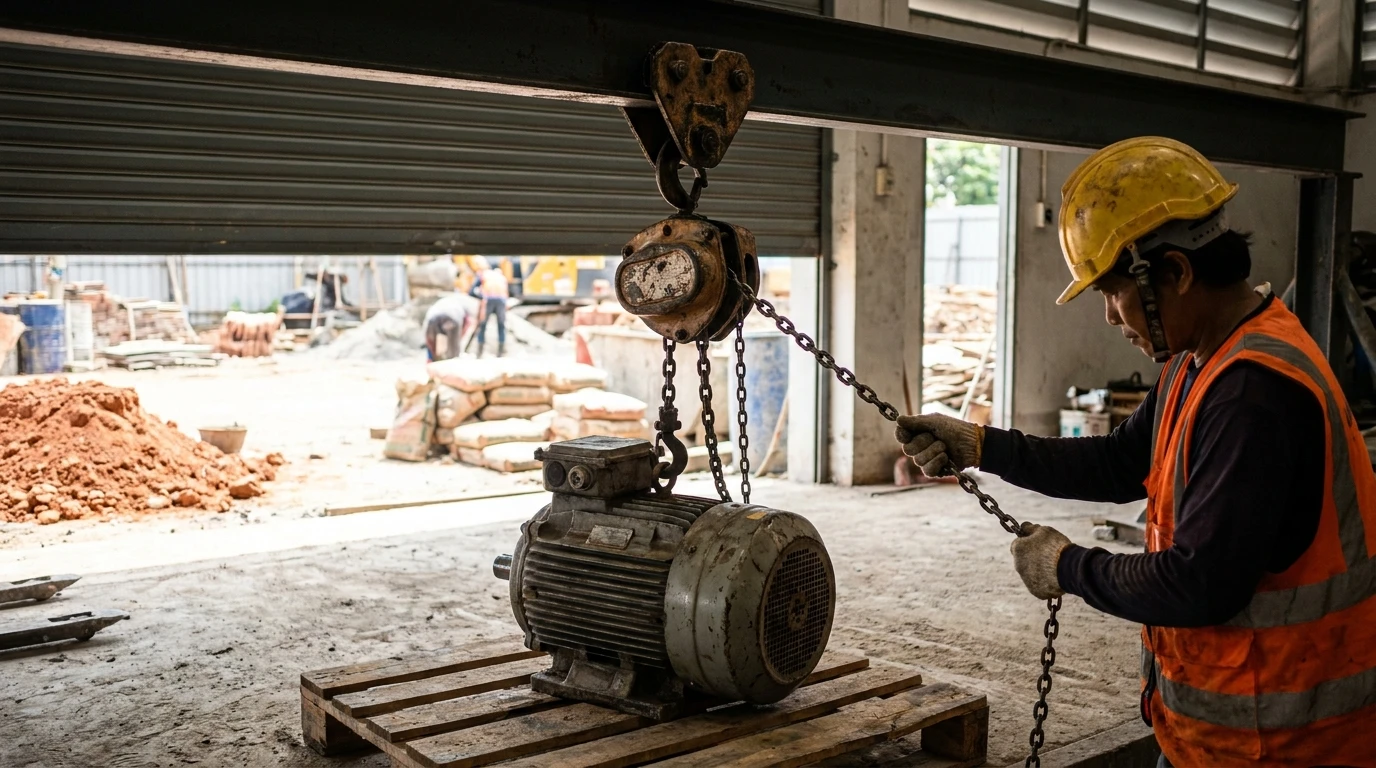
A chain hoist, called a chain block on most sites, is a gear train in a steel housing with two chains. One is the hand chain you pull; the other is the load chain with the hook on the end. Pulling the hand chain multiplies the force many times over, so one person can raise several hundred kilograms, and a friction brake holds the load in place the moment you stop pulling.

What keeps it the standard tool for site lifting is that it needs no power at all, works in tight spaces, and lifts slowly enough to place a load to the centimetre. Setting a machine down on its mounting pad wants exactly that, not speed. At 15 to 20 kg the unit itself is a one-person carry up to wherever it is being rigged.

People often search for an electric hoist, which is a different machine: it lifts on a motor instead of muscle and needs power on site. What is on hire here is the hand-operated chain hoist, and the mortar hoist, which is an electric machine for raising material up a building rather than an overhead block.

One more thing worth stating at the outset: there are no crane trucks and no hiab trucks on hire here, because there is no driver on staff. Work that needs very heavy lifting, or lifting several floors up, is not work this shop takes. If that is what the site needs, say so on the phone and nobody spends a morning waiting for a truck that was never coming.

Renting a 1-Ton Chain Hoist: the 1 Ton Is About the Anchor Point, Not the Hoist

The 2.5 to 3 Metre Lift Is the Real Boundary of the Job, Not a Footnote

The standard lift of about 2.5 to 3 metres is how far the bottom hook can travel, from its highest position to the end of the chain. It is not the height of the anchor point; it is the hoist's own stroke. Rig one on a beam 4 metres up and the bottom hook still only reaches down to around 1 to 1.5 metres off the floor.

So a lift that has to go 3 metres off the floor in a single pull needs an anchor higher than that plus enough stroke to reach back down, which a shophouse or a low factory bay usually does not have. What crews actually do is lift in stages, resting the load on an intermediate platform and moving the anchor up a level, which costs time and has to be planned in advance.

If the job is raising material several metres up, trip after trip, say mortar or tile to a third floor, a chain hoist is the wrong answer. The mortar hoist suits it far better: the general class reaches roughly 15 to 20 metres and takes around 100 to 200 kg per trip. It is also 500 THB per day.

The dividing line is easy to hold on to. Heavy, not far off the floor, and it has to land precisely: chain hoist. Lighter, several metres up, and repeated many times: mortar hoist. The two cost the same, so price is not the deciding factor; the shape of the work is the only thing to weigh.

How Much the Anchor Point Has to Carry, Worked Out Before You Rig Anything

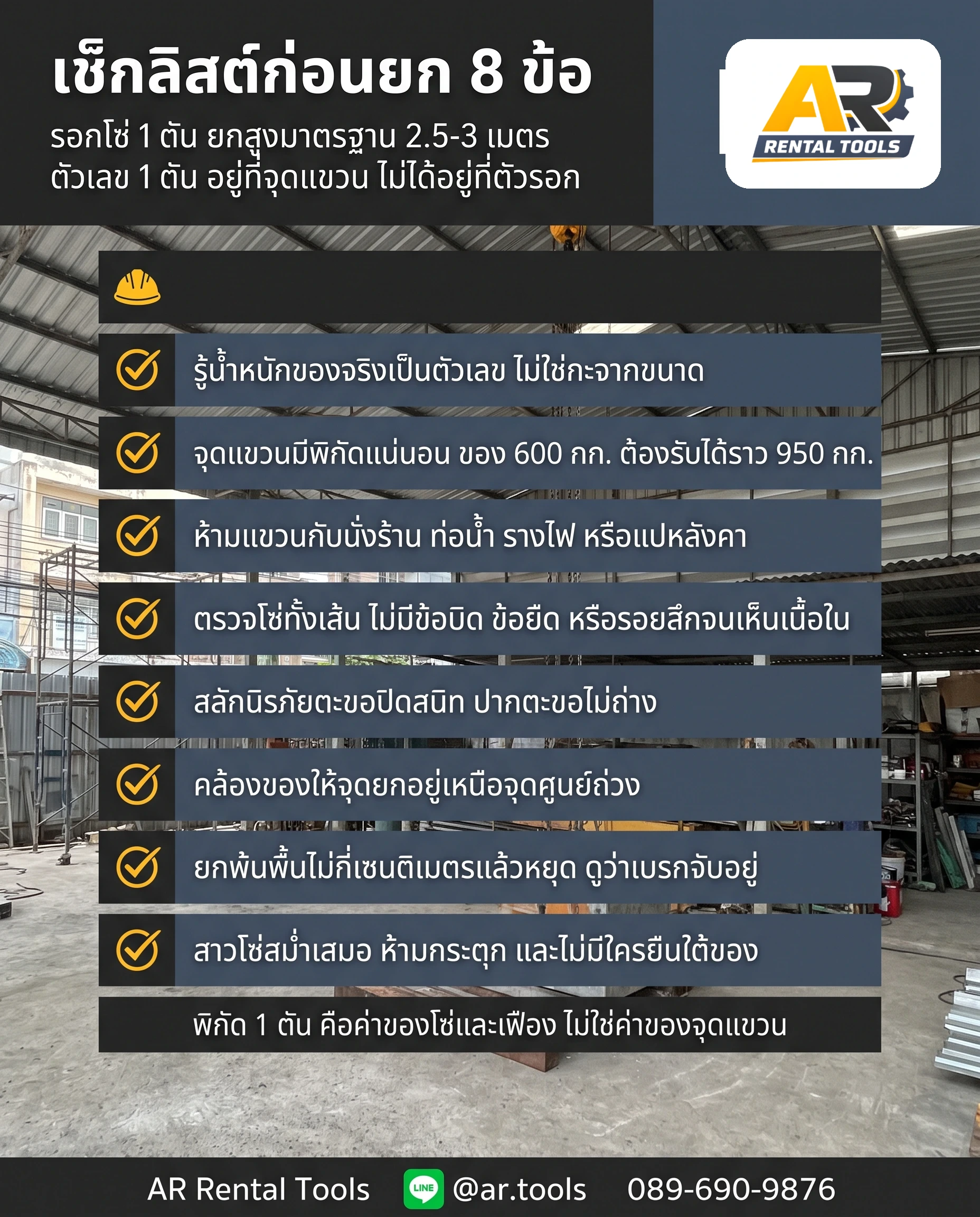
Start with the number that actually lands on the anchor. Take the load, add the hoist at 15 to 20 kg, add the slings or shackles, then allow for shock loading at no less than half the running total again. A 600 kg load should therefore be planned against an anchor rated around 950 kg or better, not 600.

There are only a few anchor points that hold up in practice. A steel or concrete beam of the building that the designer has rated for the load. A steel frame built specifically for the lift and calculated beforehand. Or a proprietary gantry with its rating printed on it. Every one of them means knowing the figure first, not looking at something thick and deciding it will probably hold.

The one thing never to rig from is steel scaffolding. Scaffolding is designed to carry weight pressing straight down through its standards. It is not designed to take a load hung from the middle of a ledger, nor the sideways force of a load that swings. Rigging a hoist to scaffolding twists the frame and brings the whole set down, and it is the accident that recurs most often in manual lifting.

Water pipes, cable tray, metal-sheet roof structure and light purlins are all in the same forbidden group. Those carry their own weight and wind loading, nothing more. If the site has no anchor with a known rating, stop and take it to the site supervisor rather than rigging something and seeing what happens.

The Eight-Point Pre-Lift Check, Under Five Minutes

One: know the real weight as a figure, not a guess from the size of the thing. Two: the anchor has a known rating, and it is higher than the total you worked out with shock loading allowed for. Three: run the whole chain through your hands for twisted links, stretched links, or wear deep enough to show bright metal, and make sure the chain is not tangled on itself before you start.

Four: check both hooks, top and bottom, that the safety catch closes flush and the throat has not opened out from its original shape. Five: rig the load so the lifting point sits above its centre of gravity, so it neither tips nor spins once it clears the floor. Six: take it up a few centimetres only, stop, and hold it there a moment to confirm the brake is holding and the load is sitting level.

Seven: keep the ground under the lift clear the whole time, with nobody walking through or working beneath a suspended load, break times included. Eight: pull the hand chain at a steady rate and never jerk it to hurry the lift, because shock loading is exactly what sends the figure arriving at the anchor past what you calculated.

The personal kit for this job is a hard hat, steel-toe boots, and gloves you can grip chain in. The gloves matter more than people expect: hundreds of pulls on a hand chain blisters bare hands quickly, and a sore hand is the hand that lets go halfway through.

Real Jobs and a Worked Budget: Shifting a 600 kg Machine Across a Factory

What a chain hoist suits most directly is a heavy load, a short lift, and a need to set it down exactly on the mark. Lifting a machine off the back of a pickup. Lowering a motor or a pump onto its pad. Raising a steel beam up against a column over two metres or less. Or taking a heavy assembly off so somebody can work behind it.

As a budget: move a 600 kg machine from the front of a factory to a pad inside, about 20 metres across the floor, with one lift up and one down over 1.5 metres each. The plan that works is to lift it onto a pallet with the chain hoist, wheel it with a pallet jack, and lift it onto the pad with the chain hoist again at the far end.

Over two days that is: the 1-ton chain hoist at 500 THB a day, so 1,000 THB. A pallet jack at 500 THB a day, so 1,000 THB. And four steel floor plates at 100 THB each per day, so 800 THB, to bridge a channel in the floor and keep the existing surface intact. Hire comes to 2,800 THB before transport.

What blows this budget out is never the daily rate, it is the number of days. A job where the anchor was settled beforehand finishes in two. A job that goes looking for an anchor once everything is on site usually turns into three or four, because now a welder has to build a frame first. That is something worth knowing before the truck arrives, not after.

The Jobs a Chain Hoist Cannot Do, and What Replaces It

The first is raising material several floors, trip after trip, as covered above: 2.5 to 3 metres of stroke is not enough and moving the anchor every trip costs more time than it saves. That is mortar hoist work at roughly 15 to 20 metres. For a lot of light material across level ground, a wheelbarrow at 100 THB a day is far quicker.

The second is lifting where there is no overhead structure at all, such as loading onto a truck in an open yard, or lifting over a fence into a site. That needs a machine with its own lifting arm, which is not on hire here and comes with no driver. The team will say so on the phone rather than let anyone wait on site for it.

The third is anything over a tonne. The number on the hoist is a maximum rating, not a working figure. A load that weighs in at 900 kg or more is a reason to step back and re-plan, not to press on because the rating has not technically been reached.

The fourth is moving heavy loads any distance horizontally over rough ground. A chain hoist lifts; it does not travel. Holding a load up and dragging it makes it swing and puts side force into the anchor, which is precisely what it was not designed to take. Use a pallet jack on a level floor, or lay steel plate to make the run level first.

How to Book So the Kit Arrives Ready to Work on Day One

Three things to give the team when you ring: the weight of the load as a figure, the lift distance from the floor to where it has to end up, and what anchor point already exists on site. If there is not one yet, say so, because that changes the whole plan and is much better known before the day.

On duration, the weekly rate is six times the daily one, so the 1-ton chain hoist is 500 THB per day or 3,000 THB per week. Most lifting jobs run one or two days and are charged by the day as used. Installation work that stretches past six days is better on the weekly rate.

There are two branches, Bang Kho Laem and Bang Khen, delivering across Bangkok and the surrounding provinces, dispatched from whichever is nearer the site. Transport is charged by distance and piece count and confirmed before booking. The full range and rates are on the equipment list, or contact the team directly.

If you are not sure whether the site has a usable anchor, photograph the structure above the lifting point, send it on LINE with the weight of the load, and the team can tell you whether the plan works or whether a different machine suits it better, all before you book.

Frequently asked questions

How much does a 1-ton chain hoist cost to rent
The 1-ton chain hoist is 500 THB per day or 3,000 THB per week. That is equipment hire only. Transport is charged separately by distance from the branch and by piece count, and the team confirms it before you book. Most lifting jobs run one or two days and are charged by the day as used.
How high can a chain hoist lift
The standard class gives about 2.5 to 3 metres per pull, which is how far the bottom hook travels, not the height of the anchor point. Rigged on a beam 4 metres up, the bottom hook still only reaches to around 1 to 1.5 metres off the floor. Higher lifts have to be done in stages.
Can I rig a hoist to scaffolding
No, and it is the single most important prohibition on this job. Scaffolding is designed to carry weight pressing straight down through its standards, not a load hung from the middle of a ledger, nor the sideways force of a load that swings. Rigging a hoist to scaffolding twists the frame and brings the whole set down.
Do you have electric hoists
In this group there is the hand-operated chain hoist, and the mortar hoist, which is an electric machine for raising material up a building rather than an overhead block. Describe the job when you ring, with the weight, the lift distance and the anchor you have, and the team will say which one suits it.
Do you rent crane trucks as well
No. There are no crane trucks and no hiab trucks on hire here, because there is no driver on staff. Very heavy lifts, lifts several floors up, and sites with no overhead structure at all are not work this shop can take. Describe the job on the phone and nobody waits on site for something that was never coming.

Get a quote

Give us the weight, the lift distance and the anchor you have, and the team can tell you whether the plan works. Call 089-690-9876 or message us on LINE at @ar.tools Send a photo of the structure above the lifting point; we reply within business hours.

← Back to articles

Content updated: 2026

AR

Ready to start your project?

Talk to our team for a quote and rental details.