

AR Rental Tools
LINE
Rental tips

Bamboo or Steel Scaffolding: the Per-Piece Rates Cannot Be Compared Directly

November 2, 202610 min read

Bamboo or Steel Scaffolding: the Per-Piece Rates Cannot Be Compared Directly

Bamboo or Steel Scaffolding: Choose on Height and Load, Not on the Per-Piece Rate

Bamboo or steel scaffolding: the first question on nearly every call is which one is cheaper, and the per-piece rate cannot answer it, because what counts as one piece is not remotely the same size between the two.

The short answer that covers most jobs runs to two lines. Light work, not very high, on a site whose shape is awkward, such as painting, sign fitting or external soffit work, usually lands on bamboo. Work that has to carry real weight, stack up several levels, or stand on site for weeks, is steel scaffolding work.

But that dividing line is about safety and fit, not about budget. Budget has to be worked out the other way round: take the quantity each one actually needs, multiply by its own unit rate, and only then compare the two results. Comparing the unit rates against each other tells you nothing.

So this guide starts with how each is counted, then moves to height, load, erection time, and the ground underneath. Current models and rates are on the bamboo scaffolding and steel scaffolding pages, or see them together under scaffolding.
What Bamboo Scaffolding Is, and What Steel Scaffolding Is

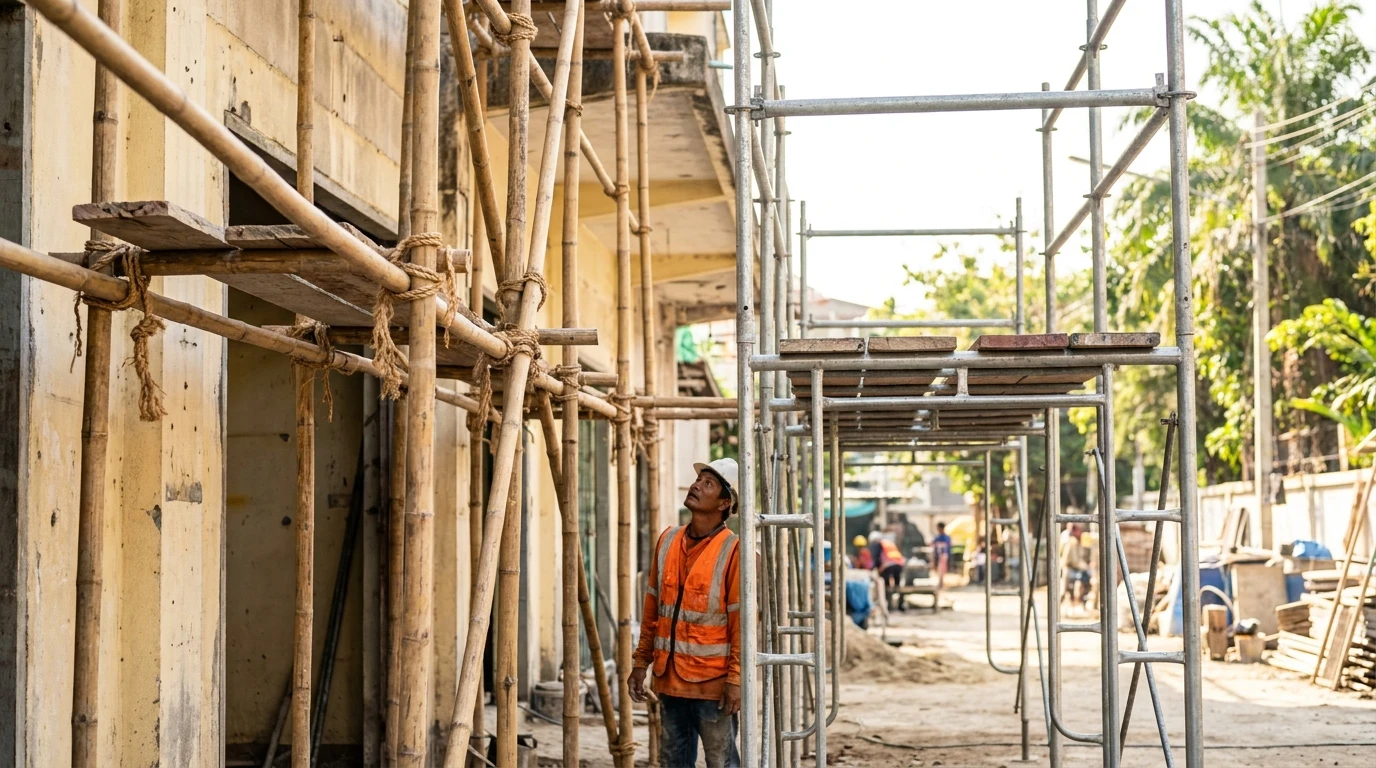
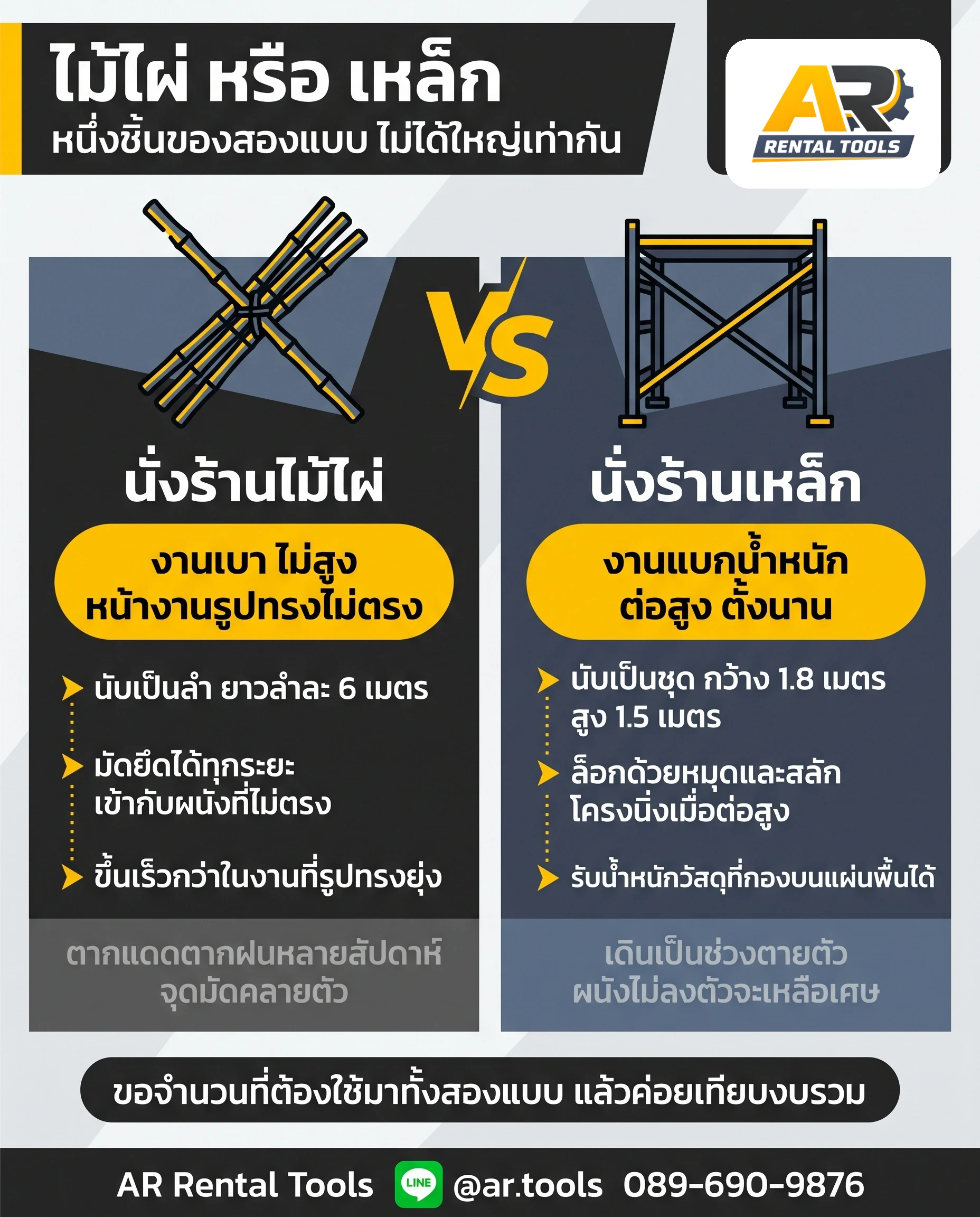
Bamboo scaffolding is built from poles roughly 6 to 8 cm in diameter and 6 metres long, set up as uprights, horizontal ledgers and diagonal braces, with every intersection lashed with rope or wire. The flexibility comes from being able to lash at any point at all, so it follows a wall that is out of true, has offset columns, or has a canopy in the way, without anything being modified.

Steel scaffolding is a system of prefabricated frame sets, standard size roughly 1.8 by 1.2 by 1.5 metres each, made up of two end frames, diagonal bracing and connectors. Sets run along horizontally and stack vertically, each locking into the next with pins and couplers, so the structure is rigid and level from the first set.

The difference that follows from those shapes is a site difference. Bamboo lashes at any spacing, so it tracks the shape of the building freely. Steel runs in fixed steps of about 1.8 metres along and 1.5 metres up. A wall whose length divides neatly into that goes up very fast; a wall that does not leaves an offcut you have to find a way to close.

Both are charged by the day on the quantity in use, and neither has a weekly rate. The day count therefore goes straight into the sum: use it for a given number of days and that is what it costs. Which means a job that overruns without a plan is a hire cost that grows every day with no ceiling on it.

Bamboo or Steel Scaffolding: the Per-Piece Rates Cannot Be Compared Directly

Why the Two Per-Piece Rates Cannot Be Compared Directly

Both are priced per piece per day, and that is exactly where people go wrong. A piece of bamboo means one pole. A piece of steel means one frame set. The bamboo pole is a straight 6 metre length. The steel set is a finished frame that is 1.8 metres wide and 1.5 metres tall in its own right.

So one steel set covers several times more wall than one bamboo pole. Steel costing twice as much per unit therefore does not mean the same job costs twice as much. On plenty of jobs the totals land very close together, and on some of them steel comes out lower.

The correct comparison is a single step. Ask for the quantity each one needs for the same site, multiply each by its own unit rate, and compare the two totals. Do not stop at comparing the unit rates, because that is comparing two things of different sizes.

When you ring, give the dimensions of the wall or area the scaffold has to cover, both length and height, and ask for a quantity in both. For ordinary jobs the team can work both out from the dimensions without a site visit, and that is the information that makes a budget comparison real.

Comparing on Height and on the Load It Has to Carry

On height: bamboo suits work that is not very high, because its joints are lashed, which resists compression well but has some give that accumulates as you stack levels. Steel locks with pins and couplers, so the structure stays truer as it goes up, and it is the only sensible choice for sustained work at height.

On load: count all of it, not just the people standing on it. One person with their own tools is one figure. But material stacked on the boards, cement bags, tile, paint drums, is often several times heavier than the person standing beside it. A job that stacks material on the scaffold is a steel job, not a bamboo one.

Duration changes the answer too. Bamboo left out in sun and rain for weeks dries and moves, and lashings that were tight at the start slacken off. A scaffold that has to stand for a long run should be steel. A scaffold that goes up and comes down inside a few days to a week or two is comfortable work for bamboo.

It reduces to three questions you can answer yourself before ringing: how high, does material get stacked on it, and how many days does it stand. If the answers are not high, nothing stacked, and only a few days, bamboo fits. If any one of them goes the other way, lean towards steel.

Comparing Erection Time, Strike Time and the Shape of the Site

Steel goes up fast where the run is straight and the ground is level, because every set is identical and locks straight in. A crew that knows the system lays out a long run quickly, and strikes it just as quickly, because it is pins out and sets lifted away one at a time.

Bamboo is slower on a straight run, because every intersection is lashed individually. But it is faster where the shape is awkward: a wall with a canopy projecting out, split levels, a lane too tight to carry steel sets into, or a face where you have to dodge pipework and cable. On those, steel has to be cut about and the offcuts closed; bamboo just lashes around them.

Transport and getting it onto site differ too. Steel sets are heavy and take up deck space. Bamboo poles at 6 metres are a length problem rather than a weight problem. A lane a truck cannot turn into, or an entrance with a low gate, obstructs each of them differently. Describe the access when you ring, so the team can plan the vehicle and the delivery runs to match.

The other thing that drives time is the crew needed to put it up and take it down. Neither is a one-person job, and that labour usually outweighs the difference in hire between the two systems. So cost the erection and strike labour in as well, not just the daily hire.

A Worked Budget: a Wall 6 Metres High and 12 Metres Long

Take an external painting job on a wall 6 metres high and 12 metres long, standing on level concrete, a straight run with nothing projecting from it. That is the fairest shape to compare the two on, because none of the awkwardness that favours bamboo is present.

The steel side can be estimated straight from the set size. A standard set is about 1.8 metres wide, so a 12 metre wall needs about 7 bays along. A set is about 1.5 metres tall, so a 6 metre wall needs 4 levels. Multiply and you get roughly 28 sets. That figure does not yet include the boards and guard rails, which are counted separately by bay.

The bamboo side cannot be estimated that way, because the pole count depends on the upright spacing the crew chooses, the number of ledgers per level, and the bracing the wall condition calls for. What you can do, and should, is ask for a pole count for a wall this size alongside the steel set count, then multiply each by its own unit rate.

With two totals in hand, multiply by the number of days you will actually use it, then add the erection and strike labour for each system. Those two combined figures are what deserves comparing, and they often come out much closer than the unit rates suggested, which is why it is worth asking for both every time.

The Ground and the Base, Which Drop Scaffolds Whose Frames Were Fine

Both systems put their entire load through the foot of each upright, which is a very small contact area for the weight going through it. Compacted ground that felt solid in the morning can settle after one night of rain, and a few centimetres of settlement under a single upright puts the whole structure out of level.

The prevention is spreading that load off the foot of the upright with a base plate much wider than the foot itself. Work standing on soil, or on a slab not yet poured, wants steel floor plate under the line of uprights, at 100 THB per plate per day. That is a very small cost against striking and re-erecting the lot.

The second thing is tying the structure back to the building once it gains height. A free-standing scaffold tied to nothing sways with the wind and with people moving on it, and the higher it goes the more it sways. Tying it to the structure at points up its height is what keeps it steady, and it is the step people in a hurry skip.

The third is boards and guard rails. Boards have to be laid out fully across any bay being worked from, not as single planks to step across, and there has to be a guard rail on every open side. Neither is an accessory; both are part of a scaffold that can be worked from. Tell the team how many bays you need so it all arrives on the first load.

If You Still Cannot Decide, and How to Book

If it is still not obvious, go back to the three questions in section four: how high, does material get stacked on it, and how many days does it stand. Those three settle it nearly every time. Leave the price question until afterwards, because it can only be answered once the quantities are known.

Four things to have ready when you ring: the length and height of the wall or area, what the ground below is, concrete or soil, how many days you expect to need it, and what the site access is like for a vehicle. That is enough for the team to come back with a quantity in both systems.

Hire is charged by the day on the quantity in use, for both bamboo and steel, and there is no weekly rate. Transport is charged separately by distance from the branch and by piece count, which matters more on scaffolding than on ordinary tool hire, because the piece count is high and it needs a large vehicle. The team confirms transport before booking every time.

There are two branches, Bang Kho Laem and Bang Khen, delivering across Bangkok and the surrounding provinces from whichever is nearer. Current listings and rates are on the equipment list, or contact the team. Send a photo of the wall on LINE with its length and height and you get a quantity in both systems back within business hours.

Frequently asked questions

Which is cheaper, bamboo or steel scaffolding
The per-piece rate cannot answer that, because one piece of each is a different size. Bamboo is counted in 6 metre poles; steel is counted in frame sets about 1.8 m wide and 1.5 m tall. Ask for a quantity in both systems for the same site, multiply each by its own unit rate, then compare the totals.
Which should I use to paint a two-storey house
Painting does not stack heavy material on the scaffold and usually finishes in one to two weeks. If the wall is not especially high and its shape is awkward, bamboo works comfortably and fits the site more easily. If it has to stand longer than that, or the ground below is soil, consider steel instead.
Is there a weekly rate for scaffolding
No. Both bamboo and steel scaffolding are charged by the day on the quantity actually in use, with no weekly rate available. The day count goes straight into the sum, so a job that overruns without a plan costs more every day. Set the strike date at the start.
Can scaffolding stand on soil
Yes, but the load has to be spread off the foot of each upright with a base much wider than the foot. Ground that felt solid in the morning can settle after one night of rain, and a few centimetres under one upright puts the whole structure out of level. Use steel floor plate under the line of uprights, at 100 THB per plate per day.
What should I tell you when I ring to book
Four things: the length and height of the wall or area to be covered, whether the ground below is concrete or soil, how many days you expect to need it, and what the site access is like for a vehicle. With those the team can come back with a quantity in both systems and the transport charge.

Get a quote

Give us the length, the height and the ground, and ask for a quantity in both systems so the budgets really compare. Call 089-690-9876 or message us on LINE at @ar.tools Send a photo of the wall; we reply within business hours.

← Back to articles

Content updated: 2026

AR

Ready to start your project?

Talk to our team for a quote and rental details.